Showing posts with label Sculthorpe Moor. Show all posts

Wednesday, 10 August 2022

Sculthorpe Moor, Discovery Day - 10th August 2022

 A return to the moor this week accompanied by ERB, not to monitor the beaver enclosure today, but situated on the boardwalk as part of a summer holidays discovery day. Nets were placed in a part of the reserve where we do not usually ring, and at a time later than usual in order to contribute to the activity day.


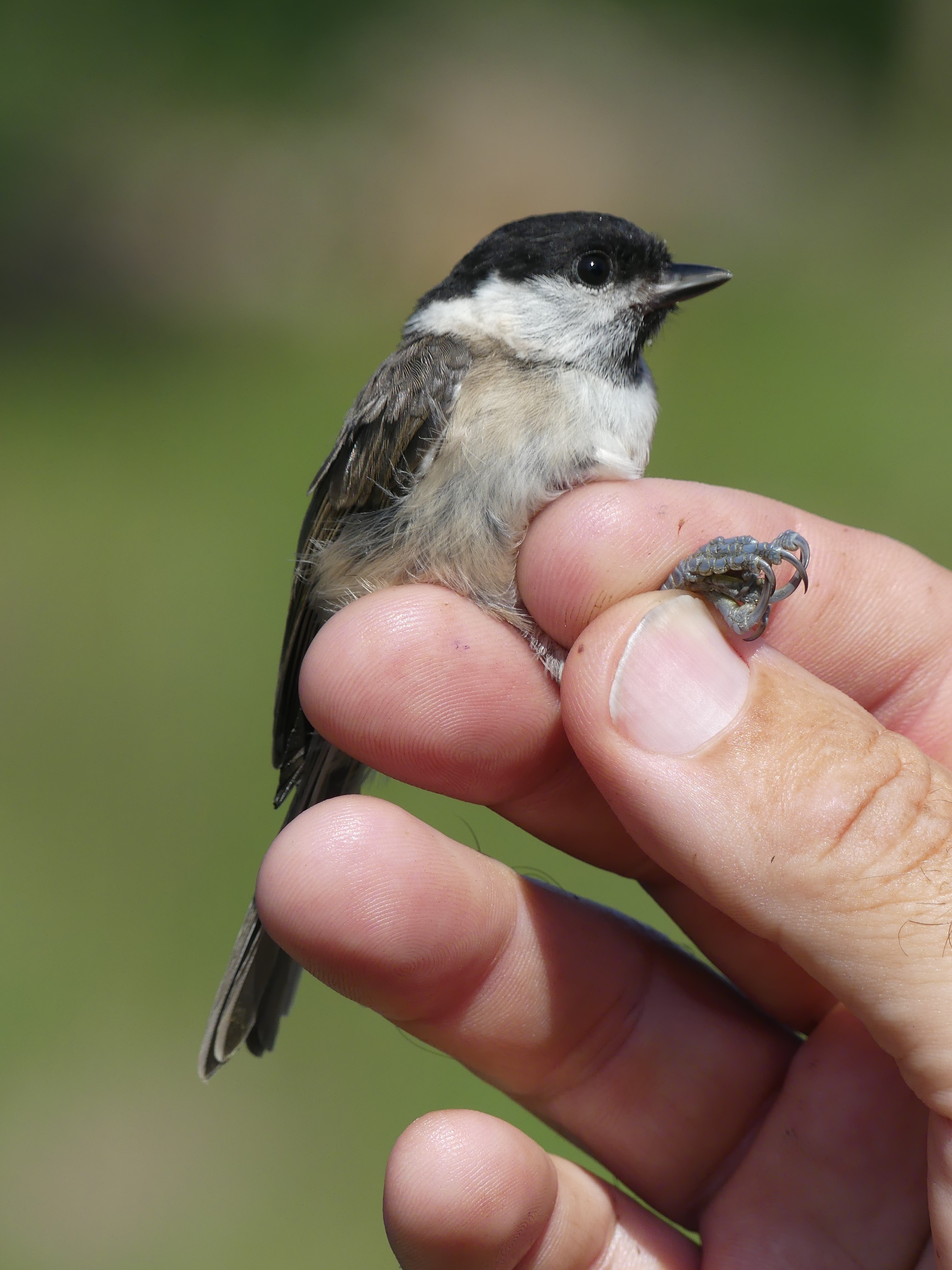
Marsh Tit

There were lots of questions about what we were doing and how the data collected informs our knowledge of wild birds. Children and adults alike discovered what happens when a bird is ringed, and how and why ringing schemes around the world work together to gather information and monitor what's happening with our wild birds. We were a little concerned that there might not be too many birds when people came by, but most visitors were able to see wild birds in the hand and several were able to release birds back into the wild.

Total: 19 (2)

Sedge Warbler - 3
Reed Warbler - 2
Whitethroat - 1
Chiffchaff - 6 (1)
Goldcrest - 1
Marsh Tit - 1
Blue Tit - 5
Great Tit - 0 (1)

Friday, 15 July 2022

Sculthorpe Moor - 15th July 2022

 We dropped in to the moor today to give one of the owl boxes a look. We had checked it two days earlier but two birds flew from the box as we arrived and it was then empty on inspection. Today we took a net, ready to catch any bird that might decide to vacate once we were by the box.

The net worked in as much as it stopped birds trying to use that exit. Chris was able to get hold of one well grown youngster although another escaped from the hatch.


The dark feathering and spotted flanks point to this bird being a female. There was no remaining down and the weight was low, so it's reached the stage of learning to hunt for itself and before long will have left the parents territory.

All necessary permits held in respect of monitoring this schedule 1 species.


Total: 1

Barn Owl - 1


Thursday, 14 July 2022

Sculthorpe Moor - 13th July 2022

ERB was a welcome addition to the team this morning. The temperature was forecast to get quite hot later in the day so we wanted to get nets up and down quickly and to be off site not long after midday. We succeeded in our aim, an extra pair of competent hands always helps and we processed 52 birds throughout the morning. There were frequent swathes of cloud and a cool breeze up until about 11am, unexpected but perfect for ringing.

Juvenile Treecreeper

Juvenile Coal Tit

3M Goldcrest

Leading species was Blue Tit, only just exceeding Chiffchaff. We continue to catch new Marsh Tits and Treecreepers, and there was also a single Willow Warbler and 3 Blackcaps. It still seems strange that we get so few Blackcaps now we're in Norfolk. Blackcaps used to be our 'big volume species' in South Bucks, during autumn we would get as many as this total session just of that species in catches extending to 3 figures, although of course the capture of Marsh Tits was unheard of at all of our then sites. Goes to show the value of ringing to record species demography and how monitoring records situation changes regionally and over time. 

Every bird, every session, we take data on species, age, weight, wing length, moult condition, fat carried, muscle status and breeding condition during the breeding season. Again permitting identification of changing trends when taken as part of the wider UK recorded data.  

Total: 48 (4)

Wren - 7
Robin - 3
Blackcap - 3
Chiffchaff - 9
Willow Warbler - 1
Goldcrest - 1
Marsh Tit - 3 (1)
Blue Tit - 9 (1)
Great Tit - 7 (1)
Coal Tit - 2
Treecreeper - 3

Sunday, 3 July 2022

Sculthorpe Moor - 3rd July 2022

 A total of 41 birds on the record sheet. Great to see Chiffchaff as the leading species today supported by plenty of resident species juveniles, including Treecreeper, Marsh Tit and Kingfisher.

Age 3M Kingfisher

Only one adult, a Willow Warbler, in full moult today, but well advanced with just the four outer primaries still to drop and change as the other primaries and tail grow in.

Four to the 3, three to the 1,two to the 1, one to the 1, zero to the 4.
Adult Willow Warbler. 

The bonus bird was a darvic marked Mute Swan, not one of the two birds in the enclosure when we last visited.

Total: 36 (5)

Mute Swan - 0 (1 darvic 4ERL read in the field)
Kingfisher - 1
Wren - 4 (2)
Dunnock - 1 (1)
Blackbird - 1
Chiffchaff - 10
Willow Warbler - 1
Goldcrest - 2
Long-tailed Tit - 2
Marsh Tit - 2 (1)
Blue Tit - 6
Great Tit - 4
Treecreeper - 1


Tuesday, 21 June 2022

Sculthorpe Moor - 21st June 2022

 A productive session at Sculthorpe Moor with a good selection of juveniles in the catch. We saw a very large mixed flock again, but most didn't travel in the direction of the nets so large numbers of Blue, Great and Long-tailed Tits were seen but not captured.

A Kingfisher was a real treat, being one of those birds that appears in the nets only once or twice a year. Here is our juvenile along with some other 'next generation' birds that have been bred at Sculthorpe Moor.

Juvenile female

Juvenile Treecreeper

Juvenile Goldcrest

Juvenile Marsh Tit

Juvenile Blackbird

Juvenile Blackcap

Both of the resident Willow Warbler pair were caught today. It is interesting to note that he is now well into his complete primary moult while she has yet to start. It has been generally observed that males of several summer migrants arrive ahead of the females, perhaps he will be leaving for the wintering grounds before her. 

We also caught a first summer male Whitethroat. We heard him singing all morning, but it appears he has been unsuccessful in attracting a mate as when caught he showed no signs of being in breeding condition.

Total: 32 (3)

Kingfisher - 1
Wren - 4
Dunnock -  (1)
Robin - 2
Blackbird - 2
Whitethroat - 1
Blackcap - 3
Willow Warbler - 1 (1)
Chiffchaff - 3
Goldcrest - 1
Marsh Tit - 2
Blue Tit - 4
Great Tit - 3
Long-tailed Tit - 2
Treecreeper - 2 (1)


Tuesday, 31 May 2022

Sculthorpe Moor - 31st May 2022

 This was to have been a full mist netting session, but due to the forecast of heavy showers during much of the morning we plumped for a window of opportunity to look for our colour marked Lapwing chicks and hopefully capture and ring the Little Ringed Plovers.

As it turned out we were able to ring all four Little Ringed Plovers that have grown a bit since we first saw them last week.

One of four Little Ringed Plovers ringed today. The necessary endorsement for targeting this schedule one species is held.

Further to that, we resighted two of the previously marked North Norfolk Lapwing project chicks and also managed to capture and ring another rather well grown chick, well past the 'hunker down and freeze' stage.


00 was seen and confirmed as still doing well, as was 01

The final chick of the day was one of two Redshank chicks observed. This is the first confirmed breeding of Redshank at the relatively new Sculthorpe scrape.

Redshank chick
All necessary permissions for the colour ringing project and targeting of precocial wader chicks granted by and conducted for the British Trust for Ornithology.

Total: 6 (2)

Little Ringed Plover - 4
Lapwing - 1 (2)
Redshank - 1

Wednesday, 25 May 2022

Sculthorpe Moor & farm in west Norfolk - 25th May 2022

 This was our second sortie for Lapwing chicks having found that the ones seen on our last attempt were too small to take the coded ring. There was no such problem today as assisted by ERB we located and captured 3 of at least 4 Lapwing young. Each was large enough to get their individually identifiable ring combination.


We also checked three Little Ringed Plover chicks that were just a little too small for metal rings. Perhaps we'll be able to find them in a week or so.

In the afternoon the farm fields were fairly productive with a total of six Lapwing chicks ringed, two of which got coded rings for the Lapwing project.


Totals: 9

Lapwing - 9 (5 colour ringed)

Saturday, 21 May 2022

Sculthorpe Moor - 20th May 2022

 We completed our initial monitoring session at Sculthorpe Moor today. With one eye on the sky as rain was forecast towards the end of the morning, we covered a small area within the 47 hectares of the beavers' enclosure, using the existing trackway between the streams and ditches, the highest point within their pen that should remain dry as the animals engineer their environment. The two animals arrived a few weeks ago and I (Denise) was lucky enough to glimpse one of the animals as we set up shortly after 6am.

The catch was low with only 13 birds, but there was a good mix of species that provided opportunity for explanation of  what data is collected and how that is done for the reserve staff who will be assisting our work from time to time . The aim is for our sessions to provide information on how the beavers' activities benefit their environment and the other species present. 

The following article on the effects of beaver within an ecosystem was published earlier this month.

 https://www.frontiersin.org/articles/10.3389/fevo.2022.873307/full

Marsh Tit

Total: 13

Wren - 4
Robin - 3
Blackbird - 1
Blackcap - 2
Marsh Tit - 1
Great Tit - 1
Treecreeper - 1