Showing posts with label Iceni Bird Monitoring Group. Show all posts

Thursday, 18 August 2022

Deepdale Farm - 18th August 2022

 The second heatwave of the summer has now passed, and we've also come through the thunder, lightning and torrential downpours that ensued once the hot spell broke. The farm tracks showed evidence that some water had been running through the farm, displacing gravel, but the fields looked in good shape with the low vegetation, whether stubble or cover crop preventing run off and loss of top soil. The ground around the area where we set nets was noticeably softer underfoot.

One of 12 Whitethroats processed today.

Lesser Whitethroat in post juvenile moult

One of two Willow Warblers. Both were hatched this year and have
 completed their post-juvenile moult in preparation for their first migration south.

As in recent sessions, Whitethroat was the leading species. The catch was a good representation of the birds seen moving about the site, five species being summer migrants.

Adult male Blackcap AXD4199 was ringed, by another ringer/group, as a juvenile in September of last year and we await details. He is currently in the process of renewing his flight feathers. Note short outer primaries that are not yet fully grown and the old lighter, outer feather that has not yet dropped and has still to be replaced.


This young Robin would have hatched fairly late in the breeding season and has barely begun to develop its diagnostic red breast as it moults out juvenile feathers in its post juvenile moult.

Additional observations included a Green Woodpecker, 2 Marsh Harrier, Red Kite, 5 Common Buzzards and a juvenile European Stonechat.

A spectacular sunrise, a perk to follow the 5am alarm.

Total: 25 (2)

Wren - 1
Robin - 2
Lesser Whitethroat - 1
Whitethroat - 12
Blackcap - 2 (1 control)
Chiffchaff - 2
Willow Warbler - 2
Long-tailed Tit - 0 (1 control)
Blue Tit - 2
Goldfinch - 1

Friday, 15 July 2022

Sculthorpe Moor - 15th July 2022

 We dropped in to the moor today to give one of the owl boxes a look. We had checked it two days earlier but two birds flew from the box as we arrived and it was then empty on inspection. Today we took a net, ready to catch any bird that might decide to vacate once we were by the box.

The net worked in as much as it stopped birds trying to use that exit. Chris was able to get hold of one well grown youngster although another escaped from the hatch.


The dark feathering and spotted flanks point to this bird being a female. There was no remaining down and the weight was low, so it's reached the stage of learning to hunt for itself and before long will have left the parents territory.

All necessary permits held in respect of monitoring this schedule 1 species.


Total: 1

Barn Owl - 1


Thursday, 14 July 2022

Sculthorpe Moor - 13th July 2022

ERB was a welcome addition to the team this morning. The temperature was forecast to get quite hot later in the day so we wanted to get nets up and down quickly and to be off site not long after midday. We succeeded in our aim, an extra pair of competent hands always helps and we processed 52 birds throughout the morning. There were frequent swathes of cloud and a cool breeze up until about 11am, unexpected but perfect for ringing.

Juvenile Treecreeper

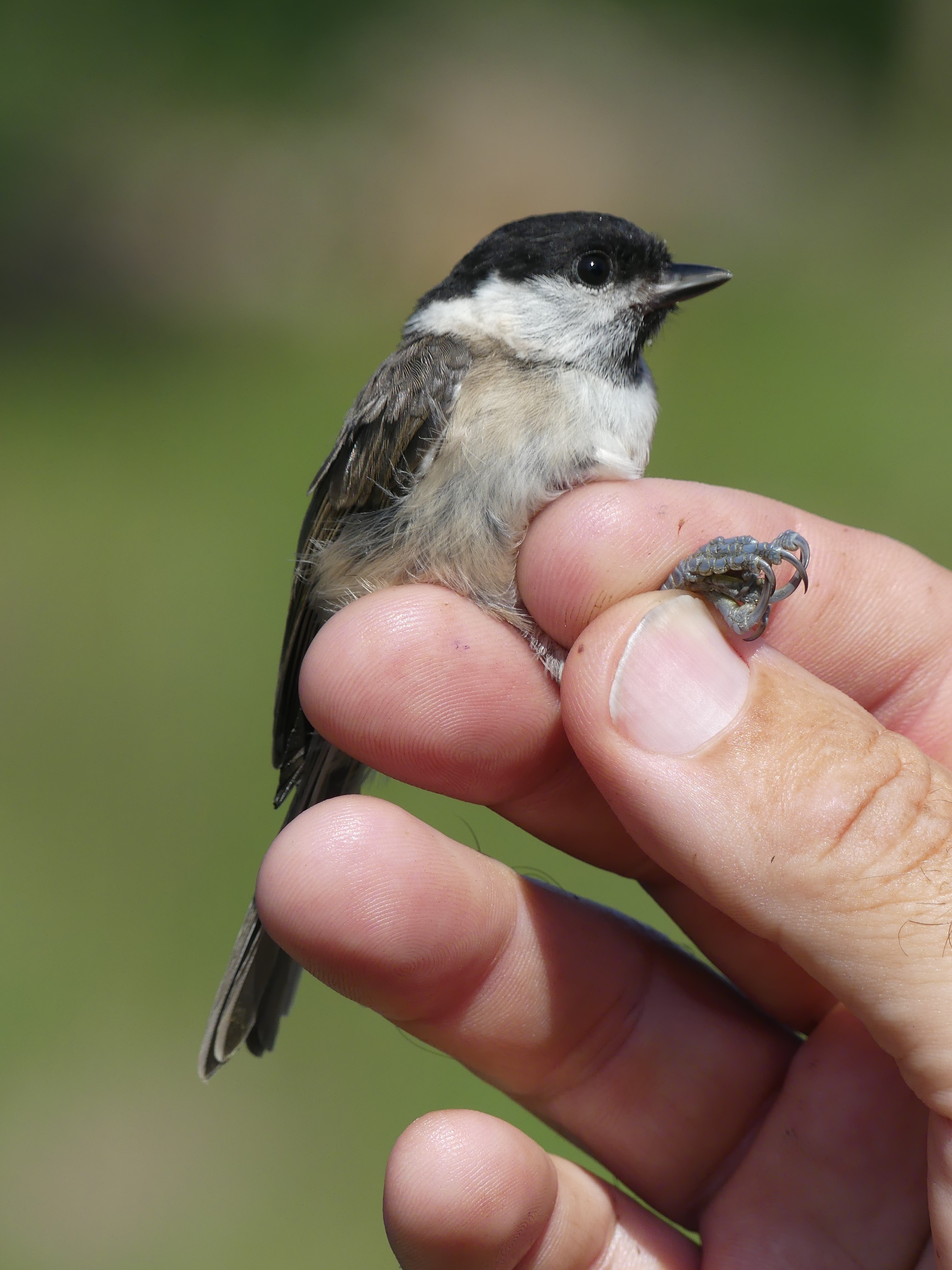
Juvenile Coal Tit

3M Goldcrest

Leading species was Blue Tit, only just exceeding Chiffchaff. We continue to catch new Marsh Tits and Treecreepers, and there was also a single Willow Warbler and 3 Blackcaps. It still seems strange that we get so few Blackcaps now we're in Norfolk. Blackcaps used to be our 'big volume species' in South Bucks, during autumn we would get as many as this total session just of that species in catches extending to 3 figures, although of course the capture of Marsh Tits was unheard of at all of our then sites. Goes to show the value of ringing to record species demography and how monitoring records situation changes regionally and over time. 

Every bird, every session, we take data on species, age, weight, wing length, moult condition, fat carried, muscle status and breeding condition during the breeding season. Again permitting identification of changing trends when taken as part of the wider UK recorded data.  

Total: 48 (4)

Wren - 7
Robin - 3
Blackcap - 3
Chiffchaff - 9
Willow Warbler - 1
Goldcrest - 1
Marsh Tit - 3 (1)
Blue Tit - 9 (1)
Great Tit - 7 (1)
Coal Tit - 2
Treecreeper - 3

Tuesday, 21 June 2022

Sculthorpe Moor - 21st June 2022

 A productive session at Sculthorpe Moor with a good selection of juveniles in the catch. We saw a very large mixed flock again, but most didn't travel in the direction of the nets so large numbers of Blue, Great and Long-tailed Tits were seen but not captured.

A Kingfisher was a real treat, being one of those birds that appears in the nets only once or twice a year. Here is our juvenile along with some other 'next generation' birds that have been bred at Sculthorpe Moor.

Juvenile female

Juvenile Treecreeper

Juvenile Goldcrest

Juvenile Marsh Tit

Juvenile Blackbird

Juvenile Blackcap

Both of the resident Willow Warbler pair were caught today. It is interesting to note that he is now well into his complete primary moult while she has yet to start. It has been generally observed that males of several summer migrants arrive ahead of the females, perhaps he will be leaving for the wintering grounds before her. 

We also caught a first summer male Whitethroat. We heard him singing all morning, but it appears he has been unsuccessful in attracting a mate as when caught he showed no signs of being in breeding condition.

Total: 32 (3)

Kingfisher - 1
Wren - 4
Dunnock -  (1)
Robin - 2
Blackbird - 2
Whitethroat - 1
Blackcap - 3
Willow Warbler - 1 (1)
Chiffchaff - 3
Goldcrest - 1
Marsh Tit - 2
Blue Tit - 4
Great Tit - 3
Long-tailed Tit - 2
Treecreeper - 2 (1)


Tuesday, 14 June 2022

Snettisham Coastal Park - 14th June 2022

 We started the session with Turtle doves purring as the nets were set. We could hear then all morning, but none were captured, so they were not represented within the 16 species caught. Of the 55 birds, 26 had been hatched this year including Lesser Whitethroat and Sedge Warbler these being some of the earlier summering warblers to arrive. There have been no young Reed Warblers as yet although the captured adults were all in breeding condition and the females had brood patches at the stage to brood eggs and/or very young chicks.

Two young Sedge Warblers with varying amounts of the diagnostic spotty
necklace remaining. 


Lesser Whitethroat juvenile

Amongst the Sedge Warbler young, one had already commenced its post juvenile moult and some Long-tailed and Blue Tits had started primary wing moult.


Total: 45 (10)

Wren - 3
Robin - 4
Dunnock - 0 (2)
Cetti's Warbler- 1 (2)
Reed Warbler - 4
SedgeWarbler - 10 (3)
Lesser Whitethroat - 2
Whitethroat - 1 (1)
Blackcap - 1
Chiffchaff - 3
Long-tailed Tit - 3 (1)
Blue Tit - 8
Great Tit - 1
Chaffinch - 1
Goldfinch - 2
Reed Bunting - 1


Tuesday, 31 May 2022

Sculthorpe Moor - 31st May 2022

 This was to have been a full mist netting session, but due to the forecast of heavy showers during much of the morning we plumped for a window of opportunity to look for our colour marked Lapwing chicks and hopefully capture and ring the Little Ringed Plovers.

As it turned out we were able to ring all four Little Ringed Plovers that have grown a bit since we first saw them last week.

One of four Little Ringed Plovers ringed today. The necessary endorsement for targeting this schedule one species is held.

Further to that, we resighted two of the previously marked North Norfolk Lapwing project chicks and also managed to capture and ring another rather well grown chick, well past the 'hunker down and freeze' stage.


00 was seen and confirmed as still doing well, as was 01

The final chick of the day was one of two Redshank chicks observed. This is the first confirmed breeding of Redshank at the relatively new Sculthorpe scrape.

Redshank chick
All necessary permissions for the colour ringing project and targeting of precocial wader chicks granted by and conducted for the British Trust for Ornithology.

Total: 6 (2)

Little Ringed Plover - 4
Lapwing - 1 (2)
Redshank - 1

Wednesday, 25 May 2022

Sculthorpe Moor & farm in west Norfolk - 25th May 2022

 This was our second sortie for Lapwing chicks having found that the ones seen on our last attempt were too small to take the coded ring. There was no such problem today as assisted by ERB we located and captured 3 of at least 4 Lapwing young. Each was large enough to get their individually identifiable ring combination.


We also checked three Little Ringed Plover chicks that were just a little too small for metal rings. Perhaps we'll be able to find them in a week or so.

In the afternoon the farm fields were fairly productive with a total of six Lapwing chicks ringed, two of which got coded rings for the Lapwing project.


Totals: 9

Lapwing - 9 (5 colour ringed)

Monday, 23 May 2022

Deepdale Farm - 23rd May 2022

We captured 18 birds today. Not too much of note although the Yellowhammers were very nice. Catch also included some juvenile Dunnocks and re-trapped Goldcrest, Robin and Chiffchaff from previous sessions.

Male Yellowhammer, age code 5


Male Whitethroat

One bird that was not ringed was a Red-legged Partridge that managed to find the net, and was successfully held. Quite an achievement for a superfine net (supplied by Merlin) to hold such a weighty bird. 

Red-legged Partridge

Although it was not possible to ring the partridge, this being a species that is bred and released on a large scale on many estates (but not from this farm) for shooting. We were able to give it a check over for flat-flies as we participate in a project to monitor these parasitic flies and it may have been possible to collect a specimen for the Hippoboscidae work. The following link is to an article with some images and interesting details about these insects. 

https://entomologytoday.org/2015/05/18/hippoboscidae-flies-live-birth/

The partridge, however, did not have any such parasites and was then released un-ringed.

Total: 14 (3)

Wren - 2
Robin - 0 (1)
Dunnock - 5
Whitethroat - 2
Blackcap - 2
Chiffchaff - 1 (1)
Goldcrest - 0 (1)
Yellowhammer - 2

Saturday, 21 May 2022

Sculthorpe Moor - 20th May 2022

 We completed our initial monitoring session at Sculthorpe Moor today. With one eye on the sky as rain was forecast towards the end of the morning, we covered a small area within the 47 hectares of the beavers' enclosure, using the existing trackway between the streams and ditches, the highest point within their pen that should remain dry as the animals engineer their environment. The two animals arrived a few weeks ago and I (Denise) was lucky enough to glimpse one of the animals as we set up shortly after 6am.

The catch was low with only 13 birds, but there was a good mix of species that provided opportunity for explanation of  what data is collected and how that is done for the reserve staff who will be assisting our work from time to time . The aim is for our sessions to provide information on how the beavers' activities benefit their environment and the other species present. 

The following article on the effects of beaver within an ecosystem was published earlier this month.

 https://www.frontiersin.org/articles/10.3389/fevo.2022.873307/full

Marsh Tit

Total: 13

Wren - 4
Robin - 3
Blackbird - 1
Blackcap - 2
Marsh Tit - 1
Great Tit - 1
Treecreeper - 1

Sunday, 8 May 2022

Wild Ken Hill - 8th May 2022

We had a beautiful day for our session at the Marsh pasture with plenty of early morning birdsong. We managed a catch of 30 birds that included a few very interesting firsts for the year. 

We caught our first Garden Warbler and also had the first young of 2022. The Long-tailed Tits were quite freshly fledged and to ensure that the whole troupe remained together, they were ringed at the net and released straight away, hence no cute photos. 

The other very interesting bird had already been ringed, but not at Wild Ken Hill. It was a control, meaning the bird has travelled from another ringing site. Now, we had a control Cetti's Warbler on 14th April that had been ringed near Broughton, Stoke Ferry, Norfolk 34km away. That bird had been ringed on 20th August 2021 and has now moved to Wild Ken Hill, is breeding and we were very pleased with the movement. Cetti's Warblers have only really started to become well established in the UK over the past 10 years or so.

Today's control, a Sedge Warbler, has been marked with a ring bearing details for the Belgian ringing scheme, another first for us at Wild Ken Hill! We do not yet have details and that may take a while, but we can say that it would have been bred in the UK and ringed in Belgium (probably - as scheme rings can occasionally be used in other countries) while on migration. Once we have the date that it was ringed, we'll know whether it was travelling to or from the Sahara at the time.

Belgian ringed Sedge Warbler. This bird was coded age 4, meaning we can only say it was hatched before the year of our capture. This is because the young and adult birds both do a complete moult on arriving at their winter quarters and the plumage has no clues as to age on return to the UK. The previous capture may provide more precise data on the year this bird was hatched.

Ring issued by the Royal Belgian Institute of Natural Sciences, Brussels, 16979731

Garden Warbler

Lesser Whitethroat with 'pollen horn', caused by foraging in flowers.
This may have developed either entirely on reaching the UK or during the the migration from East Africa through Europe.

Spot the Cuckoo and the decoy.

As usual, there were plenty of birds that we didn't catch, and that included three Cuckoos. We did try using a plastic decoy, but to no avail.

Total: 22 (8)

Dunnock - 0 (1)
Robin - 0 (1)
Cetti's Warbler - 0 (1)
Sedge Warbler - 4 (4)
Lesser Whitethroat - 2
Garden Warbler - 1
Blackcap - 3
Chiffchaff - 0 (1)
Long-tailed Tit - 9
Blue Tit - 1
Chaffinch - 1
Reed Bunting - 1


Monday, 2 May 2022

Wild Ken Hill - 2nd May 2022

 Today we monitored Siberia plantation, hoping that there would be some re-trapped birds that had been spent the previous summer or summers there. We were not disappointed. Six of the birds caught already had rings, allowing us to add to the individual history of each bird. Notable, was  male Willow Warbler that has clearly settled on his territory for the season, that was present last summer. Other re-traps included Blackcaps, Chiffchaff, Wren and Blackbird, which also included a Blackcap not ringed at the site, for which details are awaited from the ringing scheme.

Bird of the day had to be a rather sleepy Tawny Owl, still out at 7am and looking as though it was past his roosting time.

Male Tawny Owl


Total: 16 (6)

Tawny Owl - 1
Wren - 1 (1)
Robin - 3
Dunnock - 2
Blackbird - 0 (1)
Blackcap - 4 (2)
Willow Warbler - 0 (1)
Chiffchaff -  4 (1)
Blue Tit - 1

Thursday, 28 April 2022

Deepdale Farm - 28th April 2022

 A rather slow morning that brought 13 birds' data to the record sheet. Joined by ERB, we were pleased to catch the first Whitethroat of the year and spent much of the morning talking about how good this little copse should be in the autumn, at an elevated position, there is plenty of  cover just a short flight from the coastal margins. Added to that a wealth of flying insects and surrounding arable fields with set aside with birds in mind.

Male Whitethroat

Total: 12 (1)

Robin - 2
Dunnock - 1 (1)
Blackbird - 1
Lesser Whitethroat - 1
Whitethroat - 1
Blackcap - 4
Chaffinch - 2

Wednesday, 27 April 2022

Wild Ken Hill - 27th April 2022

 After a few days of warm spring sunshine, today's cloudy conditions and chill wind was a bit of a shock to the system for both ringers and birds alike. There was visibly less bird activity, and bird song was also reduced.

The female Marsh Harriers were seldom seen with only the males hunting. Presumably, brooding duties (whether eggs or chicks) were a priority in the chilly conditions. A male Cuckoo was heard from time to time, but there was no sound to indicate the presence of any females. Three Swallows flew through from the direction of the sea bank.

With little obvious activity, a total of 34 wasn't at all bad for a spring catch (always lowish, due to birds being more 'experienced' than the rather naive youngsters of autumn and with many of the paired birds sitting).

The session brought our first Reed Warbler and Grasshopper Warbler of the year. More than a third of the catch were retraps, again showing how site faithful resident and migrant birds are, often returning the exact same portion of the field, reeds or hedgerow year after year.

Grasshopper Warbler


Lesser Whitethroat

Reed Warbler


Total: 22 (12)

Wren - 1 (3)
Dunnock - 1 (1)
Song Thrush - 0 (1)
Lesser Whitethroat - 1
Reed Warbler - 1
Sedge Warbler - 4 (2)
Grasshopper Warbler - 1
Blackcap - 2
Chiffchaff - 8 (2)
Goldcrest - 1
Long-tailed Tit - 1 (2)
Reed Bunting - 1