Tuesday, 4 June 2013

Stanwell Moor - 1 June 2013

We went for an evening session, mainly to check out whether we had a Starling roost, so were slightly alarmed, as we drove down, to find that a Little Ringed Plover on the access road, was behaving as though there were chicks close by. We stopped the car and saw a small chick close to some piping. It didn't sit tight as we expected and decided to make a run for it. Without the benefit of the hand net we were most surprised to manage to catch it. There was no sign of any other chicks so it was quickly processed and returned to the gravel, and we went to put up the nets.

We set three nets in the reeds, two between the brambles and a single in the filter bed. We only got 8 birds, but there were a couple of new Reed Warblers, one from last year and another, Y224407, that was done at Bedfont, one of the groups other sites, on the 26th August 2012 as a 3. There was also a retrapped 4F Reed Bunting, Y335436, done on 21st April 2012 and then aged 4.

 4F Reed Bunting

We were able to confirm that the Starlings are back, with some 200 individuals roosting around the lake edge - in exactly the same place as last year. We even managed to catch one of the juveniles.

3J Starling

Totals: 5 (3)

Little Ringed Plover - 1
Reed Warbler - 2 (2)
Blackcap - 1
Starling - 1
Reed Bunting - 0 (1)

Friday, 31 May 2013

Blakeney Point - 30 May 2013


A second day of rain had us debating whether to stay and risk a good soaking or take an early drive home, but we thought we’d see whether the coastal weather differed to that 10 miles inland before giving up. We arrived at Cley beach car park to find that rain had given way to a thick mist and perhaps rashly opted to walk Blakeney Point in the damp and murk of the day.

Setting off

Sea Pink and a boat called Blue


As always the shingle made walking very hard work but we made our way along, taking in the wild flowers, Terns, nesting Oystercatchers and Avocets on the way. We made note of a colour ringed Avocet, Red over Black (left) & Yellow (right) and saw the female Red-backed Shrike at just a little over half way along. 

Shelducks in the dunes

Shoe find - odd and more than a bit creepy

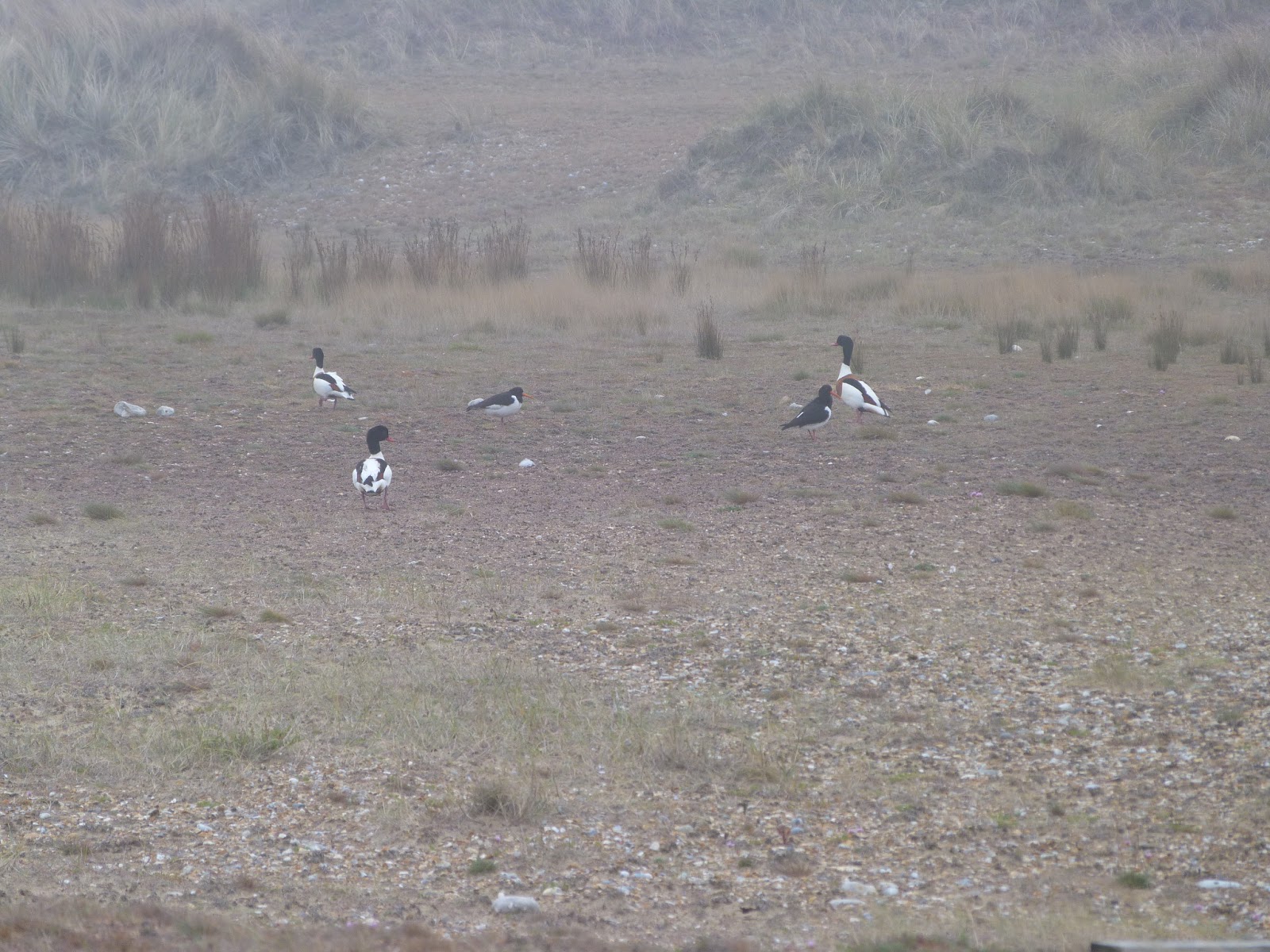
In the dunes we came across some large groups of Shelduck, nesting in rabbit holes and a peculiar arrangement of footwear ( rubbish or art  – we weren’t really sure).
We continued to the point whereupon we suddenly found ourselves in school holiday land as several families with young children, newly disembarked from the boat, fractured the natural sounds with excited shouts and screams.

View from the point

 After a brief scan across the water we retreated the way we had come up and stopped to check out some mature tamarisks and the rather grandly named plantation, a collection of diverse bushes and small trees, finding a Spotted Flycatcher and Willow Warbler.  

The plantation

 Spotted Flycatcher

On the walk back, we saw another Spot Fly and 4 more Willow Warblers. We later found out that we’d missed the male Red-backed Shrike and two Wrynecks from the previous day but really didn’t mind considering the poor visibility and strong wind that had affected conditions for much of the day. At least we didn't get wet!

Titchwell and Sculthorpe Moor - 28 May 2013


Titchwell
Another chilly, windy day! The water levels were high but we still enjoyed the sight of a few remaining winter waders including Bar-tailed Godwit among the Geese, Ducks and Gulls. We also watched Mediterranean and Little Gull and enjoyed seeing many Avocet including one pair with three young.

 Avocets on the saline pool

Wall Brown


Dragonfly pool

Water Vole

A mammal that we rarely see on our days out is the Water Vole so the chance to get some shots of this animal was most welcome. 

Titchwell beach 

Sculthorpe Moor


A pleasant sheltered walk under mature trees allowed us the chance to pin-point Marsh Tit in the canopy while listening to nest bound chicks cheeping from many of the nestboxes. There was brief amusement at orange life belts anchored to wooden benches - health and safety gone mad alongside the mud lined ditches.  

Reed Bunting, Chaffinch and Greenfinch at feeding station

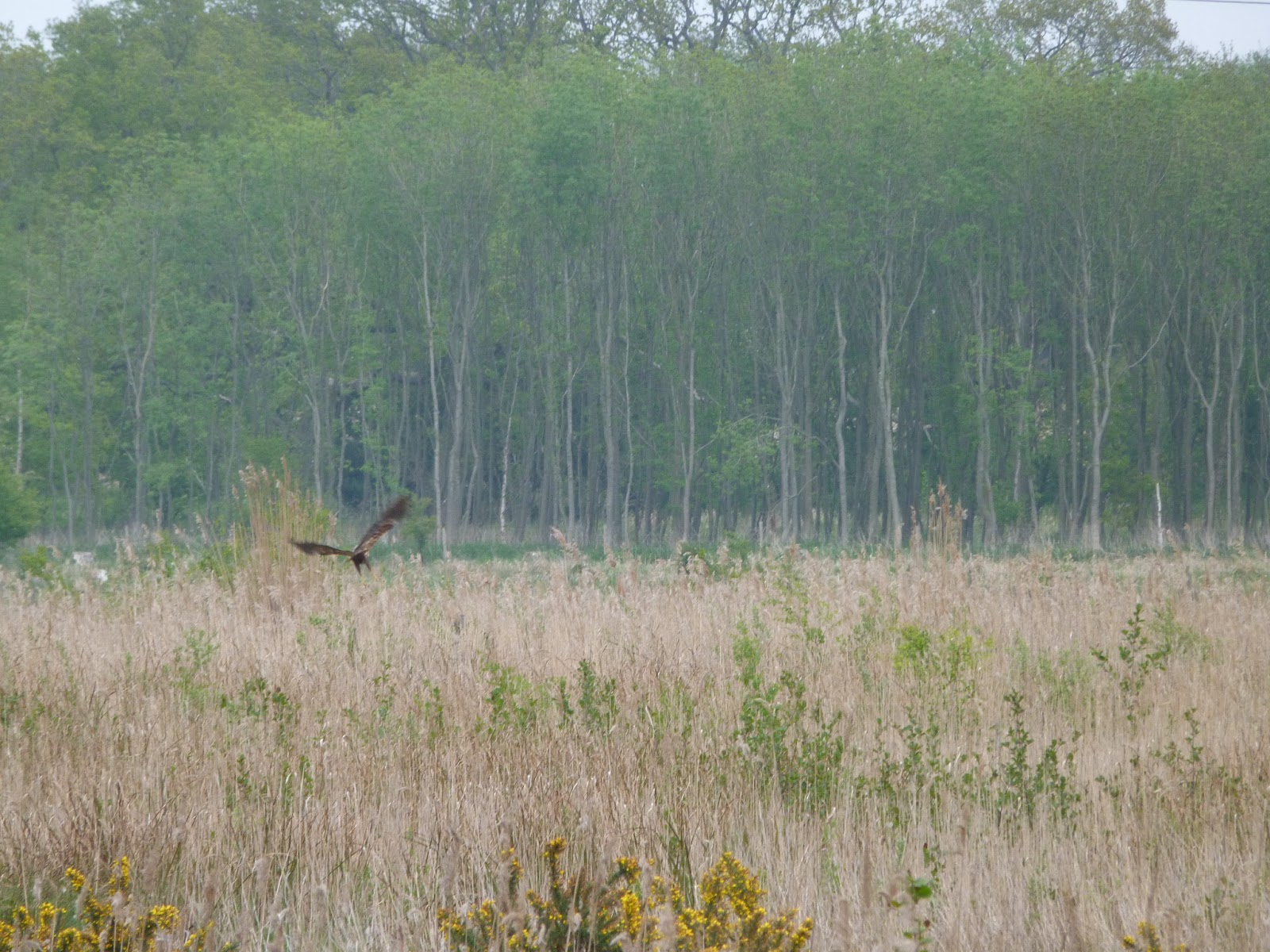
We watched a range of species taking advantage of a feeding table and enjoyed the comings and goings of a female Marsh Harrier, known to have seen more than 30 chicks to fledging since the reserve was first opened.  

Marsh Harrier at nest site

Lakenheath Fen - 27 May 2013

Lakenheath Fen
We’ve been visiting this location since before it was taken over by the RSPB. On arrival we found the car park absolutely heaving as a Red-footed Falcon and Savi’s Warbler were attracting more than the usual number of visitors.
We started off at the New fen view point with up to 9 Hobbies riding the wind and hawking for Dragonflies. We spent some time there but never saw the Red-foot.  Apparently it had been about earlier in the morning but received some rough treatment from a Sparrowhawk and  was last seen heading off the reserve, putting as much distance between it and the aggressor as possible.  


Moving via the track beside the poplar plantations, (no sign of the one and only Golden Oriole) we scoured the reed beds for Dragon and Damselflies but found few in the strong, chilly wind although the Swifts  seemed to be enjoying the wind and sunshine. Bittern could be heard booming off in the distance.


Later we spent some time trying to hear and see the Savi’s Warbler. It first began to reel just after 5pm but we only knew that we’d seen it for sure, and then the glimpse was only brief, some two hours later.

We spent a lot of time watching this bush and the surrounding reeds and eventually the Savi's Warbler showed itself.

Sunday, 26 May 2013

Yoesden Bank - 26 May 2013

After the morning ringing session a quick afternoon visit was made to Yoesden Bank to see if any Adonis Blue had emerged, but despite spending a couple of hours on the bank, none were seen, though over 20 Dingy Skippers were seen, along with a single Common Blue, two Small Blues and Orange Tips, five Green Hairstreak, and over ten Small Heath and Brimstones. As well as the usual Red Kites and a single Buzzard, a family group of six Ravens were seen.

Dingy Skipper

Green Hairstreak

Small Blue

Common Blue

 Ravens

Bedfont Country Park - 26 May 2013

Today we joined DGH and DSB for CES 3 at Bedfont Country Park. As is usual for the site at this time of year, there were more retrapped than new birds. The birds kept us occupied throughout the morning with Reed Warbler being the leading species, including two birds bearing a V prefixed ring, used in 2007. A Stockdove provided DKL with a very much unexpected new species.

 Stock Dove

 Willow Warbler

 Reed Warbler Age 5
 

Azure Damselfly

Totals: 14 (18)

Stock Dove - 1
Great Spotted Woodpecker - 1
Wren - 0 (2)
Robin - 1
Dunnock - 1 (1)
Blackbird - 1 (2)

Reed Warbler - 3 (8)
Blackcap - 0 (1)
Garden Warbler - 1
Willow Warbler - 1 Long-tailed Tit - 1

Great Tit - 0 (2)
Blue Tit - 0 (2)
Jay - 2
Greenfinch - 1

College Wood, Wicken Wood and Pitstone - 25 May 2013

Today was supposed to be the warmest and brightest of the weekend - the forecast was wrong, again, but we decided to go with our plans anyway and try out luck looking for butterflies.

First stop College Wood, hoping for Wood Whites. It seemed unlikely as it really wasn't very warm, and although a few brief spells of sunshine encouraged other species out, the Wood Whites remained elusive.

 Speckled Wood

 Female orange Tip

Green-veined White on Blue Bugle

Moving on to Wicken Wood there were even fewer butterflies to be found. We were moving on to the next site when, against all odds we found what appeared to be a single newly emerged individual.

 Wood White

Our final location, Pitstone produced plenty of Small Blues, that were our main target, with the bonus of Dingy and Grizzled Skippers. By now there was uninterrupted sunshine and the temperature was on the rise although the wind was still chilly.

 Small Blues


 Grizzled Skipper

Dingy Skipper