Tuesday, 13 June 2017

Birding in West Virginia 26th May - 2nd June 2017


This part of the trip was very much a laid back approach. We did not venture out in the field until 28th when we made a visit to Pricketts Fort SP, the main reason was to try and see if we could locate the Kentucky Warbler seen/heard here recently, without success but we did pick up a nice pair of Eastern Bluebirds, Eastern Towhee and Baltimore Oriole. A Killdeer nest was located a bit too close to a track.

Killdeer nest.


 Cedar Waxwing

In the afternoon we tried another area where several Kentucky Warblers had been reported at South Bunners Ridge, and at one location we found one singing male, unseen and at least another four, where we did manage to see one male, a new bird again for us. We also had American Redstart, Willow Flycatcher and White-breasted Nuthatch.

On 29th we only wandered as far as West Virginia University's Core Arboretum in Morgantown where we had a brief fly over Pileated Woodpecker and better views of a Swainson's Thrush.

The next day, the 30th we headed back towards Pricketts Fort SP, visiting the nearby Valley Falls SP were Woodpeckers seemed fairly visible, plus a Broad-winged Hawk floated over.

Pileated Woodpecker

Northern Flicker

By the river there was an area attracting butterflies down to salts.

Silvery Checkerspot

Zebra Swallowtail

The next day, the 31st we headed down to the Caves at Smoke Hole Cavern. 


On the way down we had eastern Meadowlark at Maysville, and after a tour of the caves we headed to the nearby Dolly Sods bog within the Monongahela National Forest where we saw Black-billed Cuckoo and Chestnut-sided Warbler. As we made out way back to Morgantown we picked up Bobolink in Laneville.

Dolly Sods

On the 1st just for a change we headed to part of the historic Cass Railroad at Durbin. We stopped off at Huntersville to look around farmland by the state prison and picked up Belted Kingfisher and during the train journey at the turn around saw a Goosander on the Greenbelt River at Hevener. 


Our final day took us to Cranesville Swamp NP and again the SatNav did what seems a WV trait, we ended up down some very narrow unmetalled roads (tracks) that even had County road numbers, the SatNav ignoring the new unmetalled road setting and the journey time was doubled, also partly due to trouble finding the reserve access road. This was another mixed woodland bog reserve which was very quiet during our visit, and the only different bird for the trip was a Brown Creeper.


White-tailed Deer

Saturday, 10 June 2017

Birding in New Jersey 9th - 25th May 2017


Whilst in New Jersey helping out with the Delaware Bay Knot project, the house we were staying on was located immediately on Reeds Beach, giving us daily great views of the Knot, Sanderling, Turnstone and Semipalmated Plover, with the odd Willet, plus the 5am hoards of Laughing Gulls that were often the cause of the morning wake up call.

Red Knot, Ruddy Turnstone and Laughing Gulls

plus some Semipalmated Sandpipers

and Sanderling.

They would be joined by a number of American Herring and Greater Black-backed Gull that took to feeding on many of the upturned Horseshoe Crabs.

Greater Black-backed Gull

One day a a dead Drum Fish turned up on the beach after the high winds and was food, not just for the Gulls, but also a Turkey Vulture.

Turkey Vulture on Reed's Beach

During our first few days we were taken out to a few local sites by Gerry who along with Gwen had been coming to help out on the project for a number of years. Gerry is quite an active birder from Ontario, so knew a number of local sites and all the bird calls.

The first day (10th) was spent at the New Jersey Audubon's Cape May Bird Observatory - Centre for Research and Education where a series of presentations were being given. Ruby-throated Hummingbirds came into the feeders, and that evening we went to the nearby Jake's Landing where throughout our visit Black Rail(s) could be heard calling, often distantly, but sometimes closer. American bird listing also heavily includes heard birds, but for someone that mainly does it on a visual basis there is little chance of any potential sightings. There were a few Marsh Wren and Saltmarsh Sparrows in the area, and whilst listening to the Black Rail, a Great Horned Owl flew out of the adjacent woods.

The next day (11th) Gerry took us to Belleplaine State Forest, one of the better areas for breeding Warblers and migrants away from the coastal migration spots. This is when you get a perspective on why the US birders rely on calls and song. The woods were quite busy with bird life, Poison Ivy and ticks, so birding from the road is the preferred option to specifically going into the forest to track down the birds for views. We did though get to see Scarlet and Summer Tanagers, Prothonotary, Pine, Prairie, Hooded, Black & White, Blackpoll Warblers and Ovenbird, White-eyed Vireo and Blue Grosbeak, plus Carolina Chickadee and Yellow-throated Warblers which were both new birds for us.

Afterwards we had a run up to Heislerville WMA which at high tide holds a very large roost of waders of mainly Short-billed Dowitchers, Dunlin and Semipalmated Plovers, with a few Grey Plovers, Willet plus the odd Greater and Lesser Yellowlegs and Spotted Sandpipers, along with Black Skimmers.

High tide roost

The main reason for the visit was to try and locate the vagrant Little Egret, which we did in due course, Gerry's second on this side of the pond.

The 12th found us all at Avalon where there is a breakwater into the Atlantic which had two late remaining Purple Sandpipers avoiding a very choppy sea, which brought 38 Northern Gannets in close enough to be visible.

Purple Sandpiper

A local sports field held some Pale-bellied Brent Geese, and nearby there was a colony of Yellow-crowned Night Herons, of which four birds were visible.

Pale-bellied Brent Geese.

The 14th had us make a brief return visit to Heislerville WMA partly to see the Slavonian (Horned) Grebe we'd missed, plus a Greater Scaup that caused a bit of debate between it being Greater or Lesser.

Great Egret

The 15th took us down to Higbee WMA which yielded Purple Martin and Cliff Swallow, Northern Parula and Yellow-rumped Warbler, Orchard Oriole and Field Sparrow. A Black Vulture, the less common of the two Vultures seen in NJ drifted over the car whilst on Cape May Island.

On the 16th, a quick visit to Beavers Swamp WMA produced a couple of Sandhill Cranes, Green Heron, a single Gull-billed Tern, Carolina Wren and Wilson's Warbler. Clapper Rail, one of a few seen during the later high tides was seen at Reeds Beach and a visit to Jake's Landing provided Magnolia Warbler in the woods.

On one of the count visits to Moore's Beach on the 17th we had the only Saltmarsh Sparrow of the trip up and showing in song, another new bird for us, along with at least 10 Seaside Sparrows on one of the few more or less windless days of the visit.

Seaside Sparrow

During another count visit on 18th at Norbury Landing we had three Royal Terns.

Royal Terns 

Immature Bald Eagle on the beach

Turnstone digging for eggs on the beach

Foster's Terns

Another visit on 19th to Heislerville WMA to join up with the Semipalmated Sandpiper ringing team and we had the usual gathering of birds.

Short-billed Dowitcher

Bald Eagle

Black Skimmer

A Black Scoter appeared on Reeds Beach on the 20th

Black Scoter

A visit back to do counts at Moore's Beach on 21st produced Swamp Sparrow

Willet (Eastern) Moore's Beach road

Belleplaine SF on 21st produced Acadian Flycatcher and Worm Eating Warbler, plus an un-seen but heard Kentucky Warbler.

Another visit on 23rd added Alder Flycatcher and Wood Thrush with a Northern Flicker out in the middle of the marsh at Moore's Beach feeding on the track.

The 24th saw us pay a visit to Stone Harbour Point where a few Piping Plover still breed, with three seen on the beach as the tide receded.

American Oystercatcher

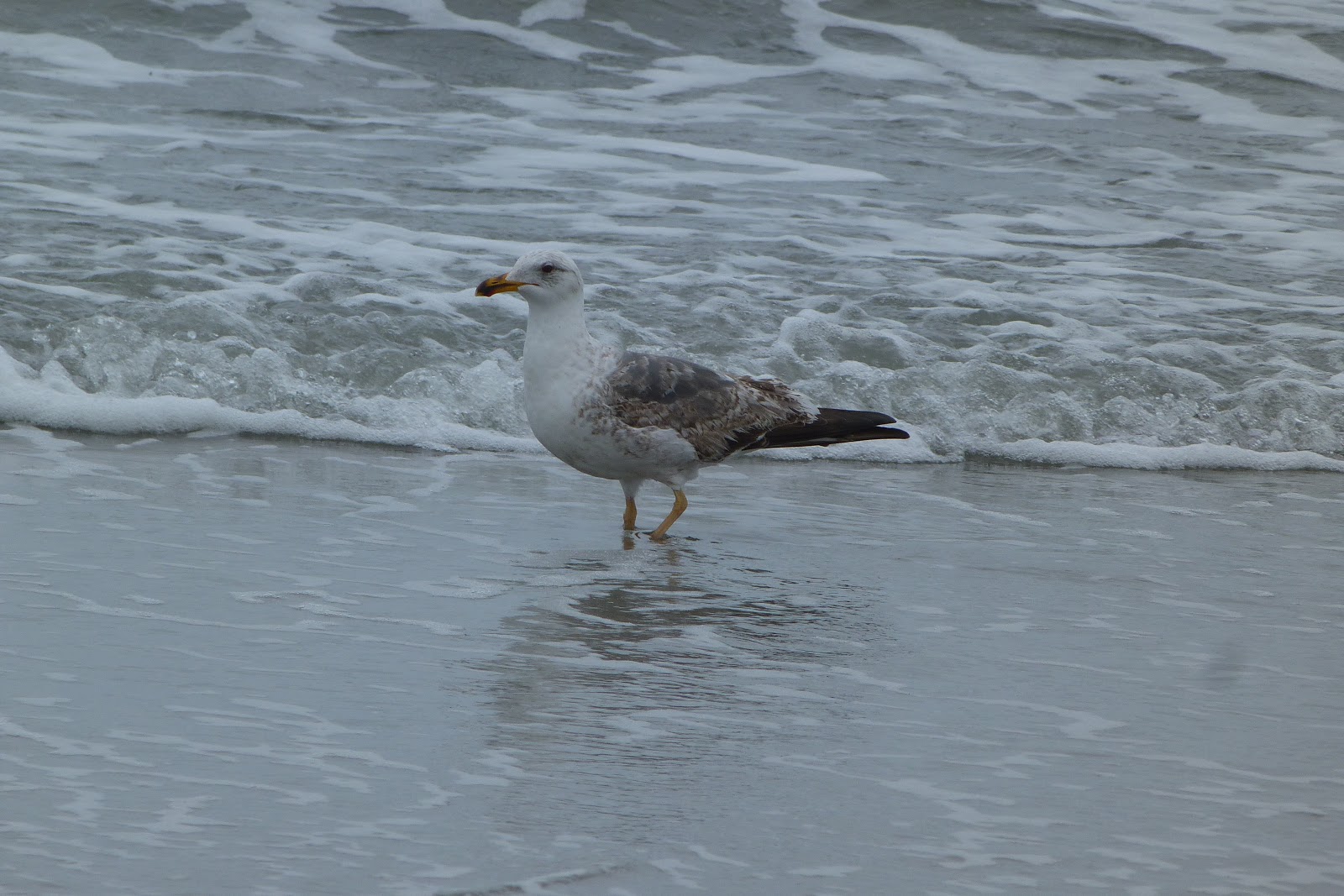
Lesser Black-backed Gull

On the way back at Mummy Island there were two Little Blue and two Tricoloured Herons, and a Wilson's Snipe.

Tricoloured Heron

Black-crowned Night Heron

The last visit was on the 25th to South Cape May Meadow Preserve to see a late American Wigeon, seen briefly before disappearing out of sight.

Song Sparrow, on Reed's Beach in the house garden.

Northern Mockingbird, another common bird on and 
around the beaches.

Wild Turkey that were often seen on roadsides. 

Friday, 9 June 2017

Mist-netting waders - Heislerville, New Jersey - 19th May 2017

Heislerville was completely flooded and full of Short-billed Dowitchers and Semi-Palmated Sandpipers when we first saw it, but now the water level was dropping and we had arranged to join David Mizrahi, of the New Jersey Audubon society, and his team to mist net waders. The session was dependent on the birds moving off the beaches at high tide so we set the nets at 11.30am. Amazingly, it is possible to catch birds this way, due to the numbers present.

David explains the process to passers by.

Mist nets at Heiserville

In unseasonably warm temperatures, keep cages and a shade are put up in case of a large catch.


Semi-palmated Plover 

Semi-palmated Sandpiper

Blood samples are taken from most Semi-palmated Sandpipers before all receive an engraved flag.


David as a little disappointed with the numbers caught but we were quite happy extracting Semi-palmated Sandpipers, Semipalmated Plovers and a couple of Least Sandpipers.

Many thanks to David and him team for welcoming us to their catch and allowing us to see how things are done on this side of the pond.

Totals:

Semi-palmated Sandpiper - 56
Least Sandpiper - 2
Semi-palmated Plover - 6


Resighting flagged birds - Delaware Bay May 2017

From the twelfth we began re-sighting of flagged birds. there was a small team of dedicated re-sighters while those from the banding team were to contribute when not engaged with catching and processing. There were several beaches to be monitored, local ones such as North and South Reeds where we were all staying, Cooks and Kimbles just along the coast then extending to Pierces, Thompsons, Moores, Norburys Landing and creek, Villas and on to Fortescue some 70km away. The 2.6 miles of restored beaches have been particularly busy in the last few years - but all beaches should be visited every three days at least.

We started with the telescope but soon found photographing better to record tags in addition of those that we had seen as the birds moved in close proximity to each other. All birds flagged in Delaware have a light green with black print or dark green with white print. Other flags used along the east coast flyway are Orange (Argentina), Dark Blue (Brazil), Red (Chile) and White (Canada).


                                            Dark Green flag engraved in white HAY

This bird was seen at Reeds North beach on the 14th and 20th. There is a long history on the report banded birds website.

http://report.bandedbirds.org/Search.aspx

Capture:
5/12/2005 3:15:00 PM - Mispillion Harbor, Delaware, United States - 1172-70916 FELGHAY REKN
Resightings:
5/30/2005 - Gandys Beach, New Jersey, United States - 1172-70916 FELGHAY REKN
5/19/2007 - Mispillion Harbor - Back Beach, Delaware, United States - 1172-70916 FELGHAY REKN
5/14/2008 - Mispillion Harbor, Delaware, United States - 1172-70916 FELGHAY REKN
5/21/2009 - Mispillion Harbor, Delaware, United States - 1172-70916 FELGHAY REKN
5/25/2009 - Mispillion Harbor, Delaware, United States - 1172-70916 FELGHAY REKN
7/24/2010 - Longridge Base, James Bay, Ontario, Canada - 1172-70916 FELGHAY REKN
8/4/2011 - Longridge Base, James Bay, Ontario, Canada - 1172-70916 FELGHAY REKN
8/5/2011 - Longridge Base, James Bay, Ontario, Canada - 1172-70916 FELGHAY REKN
8/7/2011 - Paskwachi Point, James Bay, Ontario, Canada - 1172-70916 FELGHAY REKN
8/9/2011 - Longridge Base, James Bay, Ontario, Canada - 1172-70916 FELGHAY REKN
8/13/2011 - Little Piskwamish - south flats, Ontario, Canada - 1172-70916 FELGHAY REKN
5/22/2014 - Mispillion Harbor, Delaware, United States - 1172-70916 FELGHAY REKN
5/25/2014 - Mispillion Harbor, Delaware, United States - 1172-70916 FELGHAY REKN

This bird is over twelve years old and was banded and regularly seen on the Delaware side of the bay but spent a good deal of its time, during the 2017 migration north on the New Jersey side.


Red flag engraved HKU

Capture:
1/23/2007 - Tierra del Fuego, Bahia Lomas, Magallanes y Antártica Chilena, Chile - 1172-98275 FERYE REKN
5/18/2016 - Reeds Beach - north, New Jersey, United States - 1172-98275 FERHKU REKN
Resightings:
5/16/2007 - Cooks Beach - north, New Jersey, United States - 1172-98275 FERYE REKN
8/16/2007 - Grande Ile, Mingan Archipelago National Park Reserve, Quebec, Canada - 1172-98275 FERYE REKN
8/17/2007 - Grande Ile, Mingan Archipelago National Park Reserve, Quebec, Canada - 1172-98275 FERYE REKN
8/18/2007 - Grande Ile, Mingan Archipelago National Park Reserve, Quebec, Canada - 1172-98275 FERYE REKN
8/19/2007 - Grande Ile, Mingan Archipelago National Park Reserve, Quebec, Canada - 1172-98275 FERYE REKN
8/20/2007 - Grande Ile, Mingan Archipelago National Park Reserve, Quebec, Canada - 1172-98275 FERYE REKN
5/21/2008 - Stone Harbor - flats at 96th Street, New Jersey, United States - 1172-98275 FERYE REKN
5/22/2008 - Grassy Sound Meadow, New Jersey, United States - 1172-98275 FERYE REKN
3/30/2009 - Palmares de la Coronilla beaches, Rocha, Uruguay - 1172-98275 FERYE REKN
5/31/2009 - Kimbles Beach - south, New Jersey, United States - 1172-98275 FERYE REKN
8/17/2009 - Grande Ile, Mingan Archipelago National Park Reserve, Quebec, Canada - 1172-98275 FERYE REKN
8/25/2009 - Grande Ile, Mingan Archipelago National Park Reserve, Quebec, Canada - 1172-98275 FERYE REKN
5/21/2010 - Hog Island - mid, Virginia, United States - 1172-98275 FERYE REKN
7/31/2010 - Ile Niapiskau, Mingan Archipelago National Park Reserve, Quebec, Canada - 1172-98275 FERYE REKN
5/26/2011 - Reeds Beach - north, New Jersey, United States - 1172-98275 FERYE REKN
5/27/2011 - Reeds Beach - north, New Jersey, United States - 1172-98275 FERYE REKN
5/28/2011 - Reeds Beach - north, New Jersey, United States - 1172-98275 FERYE REKN
7/17/2011 - Ile Niapiskau, Mingan Archipelago National Park Reserve, Quebec, Canada - 1172-98275 FERYE REKN
7/18/2011 - Ile Quarry, Mingan Archipelago National Park Reserve, Quebec, Canada - 1172-98275 FERYE REKN
5/21/2012 - Kimbles Beach - south, New Jersey, United States - 1172-98275 FERYE REKN
8/12/2012 - Grande Ile, Mingan Archipelago National Park Reserve, Quebec, Canada - 1172-98275 FERYE REKN
5/16/2013 - Cooks Beach - south, New Jersey, United States - 1172-98275 FERYE REKN
5/17/2013 - Cooks Beach - south, New Jersey, United States - 1172-98275 FERYE REKN
5/17/2013 - Kimbles Beach - south, New Jersey, United States - 1172-98275 FERYE REKN
5/19/2013 - Cooks Beach - north, New Jersey, United States - 1172-98275 FERYE REKN
5/19/2013 - Reeds Beach - south, New Jersey, United States - 1172-98275 FERYE REKN
5/28/2013 - Cooks Beach - north, New Jersey, United States - 1172-98275 FERYE REKN
8/7/2013 - Grande Ile, Mingan Archipelago National Park Reserve, Quebec, Canada - 1172-98275 FERYE REKN
5/20/2014 - Reeds Beach - south, New Jersey, United States - 1172-98275 FERYE REKN
8/11/2014 - Grande Ile, Mingan Archipelago National Park Reserve, Quebec, Canada - 1172-98275 FERYE REKN
5/16/2015 - Kimbles Beach - south, New Jersey, United States - 1172-98275 FERYE REKN
5/9/2016 - Reeds Beach - south, New Jersey, United States - 1172-98275 FERYE REKN
5/22/2016 - Reeds Beach - south, New Jersey, United States - 1172-98275 FERHKU REKN
5/22/2016 - Sunray Beach Preserve, New Jersey, United States - 1172-98275 FERHKU REKN
8/13/2016 - Grande Ile, Mingan Archipelago National Park Reserve, Quebec, Canada - 1172-98275 FERHKU REKN
8/15/2016 - Grande Ile, Mingan Archipelago National Park Reserve, Quebec, Canada - 1172-98275 FERHKU REKN
5/21/2017 - - 1172-98275 FERHKU REKN
5/24/2017 - - 1172-98275 FERHKU REKN


These are just two of the Red Knots recorded. We also collected data on Sanderling, Ruddy Turnstone and Semipalmated Sandpipers. This year the symbols +, =, # and % have been used to increase the number of individualise codes available.


=HL, flagged this year, forages along the rising tide line.

In addition to recording flags we also did flagged to un-flagged ratios, flock counts and inter-tidal counts to feed into the shorebirds study.

As our time there progressed it became clear that the numbers of waders were not building up as expected. There has been little spawning of the Horse-shoe crabs, probably due to generally cold air and water temperatures, strong onshore winds some days and this has affected the numbers of available eggs for the birds to eat. Birds have been forced to dig for eggs rather than just eat loose eggs off of the surface of the sand. Turnstones do this most readily, defending their excavation and the eggs within from other birds. It was clear that pickings were quite thin along the shoreline. Added to this, difficult weather conditions to the south were thought to be a reason behind the lower numbers of birds in the bay.


Turnstones excavate where Horseshoe crab eggs were laid. 


Combined counts never exceeded 4000 and an aerial count on the 21st confirmed that there were indeed a substantial number of the expected birds missing. Further to this the birds present were not at the expected locations of Cooks and Kimbles, with the bulk being at Norbury on the aerial count day. There was some spawning over the next couple of days but not on the usual scale so egg availability remained low. 


With very few eggs on the beach surface birds cluster around two egg laying sites 
as the rising tide agitates the sand and dislodges some eggs.

For more on the progress of migrating Red Knots and Turnstones see the link below.


http://www.conservewildlifenj.org/blog/2017/05/24/in-dangerous-territory-on-the-delaware-bay/

We continued with resightings until the 25th of May. All of our flagged birds ( over 1000) were entered into a data sheet and handed over before our departure. Some 90% will also have photographic evidence to confirm the resightings. 


A Canadian flagged bird ringed in 2016

TT1, ringed before 2014 in Tierra del Fuego 

 PAX was flagged on 21st October 2016 at Avalon, New Jersey 
(so NOT during the spring migration flagging efforts).


A6T ringed 1st March 2013 - Ilha de Curupu, Maranhao, Brazil 
In spite of the print wearing away identification is possible from the photograph.


Sanderling P0K


Ruddy Turnstone MPV

When our time with the Red Knot project came to an end it was still unclear where the remainder of the migrating birds were - further information should come through on the link given above.

Special thanks to Humphrey for making it possible for us to participate on the project, and to Gwen, Gerry, Angela, Barrie, Peter and Guy - who brought us up to speed, showed us some excellent birding spots and helped with identification of birds by call and song, were good house mates and excellent company. 


Optics used were an Opticron HR80 scope (product code 41006), SDL eyepiece (product code 40936). In addition the Universal tele-adapter UTS (product code 40951) provide additional zoom capabilities to read rings at a great distance. Thanks to Opticron for optics support.