24th March
Today we made our way to the International Bird Research Centre Eilat. We were surprised to find that Elon, who we had met at Yeroham, Negev last year was volunteering there and ringer-in-charge, and he was surprised to find that we were the help that he had been told of. Another ringer that we know Francis Argyll, was also there for the next few days. Carmelle was the volunteer ringer from Spain, staying for three months. We familiarised ourselves with the site, systems and processes. There were 17 nets, records were to be entered directly into Excel and nets were dropped at 6am - we'd be there from the start tomorrow. We had a look around the rest of the reserve.


Birds seen at IRBCE: Marsh Harrier, Black Kite, Steppe Buzzard, Steppe Eagle (3), Booted Eagle (1), Whitethroat (1), Purple Heron (3), Squacco Heron (1) Eastern Bonelli's Warbler, Savi's Warbler (1), Little Green Bee-eater (2), Citrine Wagtail (1 male), Eastern Olivaceous Warbler (1), Snipe (1), House Martin and Red-rumped Swallow.
After finishing at the IBRCE we drove to the KM20 pools: Marsh Sandpiper, Shelduck, Ringed Plover, Little Ringed Plover, Black-winged Stilt, Pintail, Kentish Plover, Glossy Ibis, Whiskered Tern (1) and Squacco Heron.


25th March
We joined the ringing again and helped with extracting birds from the mist nets. The most interesting bird for us was a Subalpine Warbler.


Next we checked out the North beach, the salt pans and the drainage ditches between them and the sea. We found two Western Reef Herons, two Pied Kingfishers and a host of migrating waders.


In a dried stream bed were some large tracks. This is not an area where people walk dogs, so potentially were wolf tracks.


Today we made our way to the International Bird Research Centre Eilat. We were surprised to find that Elon, who we had met at Yeroham, Negev last year was volunteering there and ringer-in-charge, and he was surprised to find that we were the help that he had been told of. Another ringer that we know Francis Argyll, was also there for the next few days. Carmelle was the volunteer ringer from Spain, staying for three months. We familiarised ourselves with the site, systems and processes. There were 17 nets, records were to be entered directly into Excel and nets were dropped at 6am - we'd be there from the start tomorrow. We had a look around the rest of the reserve.

Little Stint - Anita Lake

Raptor watching hide

Sedge Warbler by Anita Lake
Birds seen at IRBCE: Marsh Harrier, Black Kite, Steppe Buzzard, Steppe Eagle (3), Booted Eagle (1), Whitethroat (1), Purple Heron (3), Squacco Heron (1) Eastern Bonelli's Warbler, Savi's Warbler (1), Little Green Bee-eater (2), Citrine Wagtail (1 male), Eastern Olivaceous Warbler (1), Snipe (1), House Martin and Red-rumped Swallow.
After finishing at the IBRCE we drove to the KM20 pools: Marsh Sandpiper, Shelduck, Ringed Plover, Little Ringed Plover, Black-winged Stilt, Pintail, Kentish Plover, Glossy Ibis, Whiskered Tern (1) and Squacco Heron.

One of the KM20 pools

Slender-billed Gull

Kentish Plover

Ringed Plover

Little Ringed Plover
A run out to Uvda for larks was much too late in the day, all the speciality larks were absent but we did see Desert Lark, Tawny Pipit (4), Stonechat (1), Short-toed Lark (c25), Blackstart (3), Pallid Harrier (one male), Red-throated Pipit (2), Black-eared Wheatear (1 male) and quite a few Spotted Sandgrouse.

Uvda Plain
25th March
We joined the ringing again and helped with extracting birds from the mist nets. The most interesting bird for us was a Subalpine Warbler.

Eastern Subalpine Warbler female
We birded Holland Park where there were good numbers of Ruppell's Warbler and Sand Partridge

Holland Park

Male Ruppell's Warbler

Pair of Sand Partridges
Next we checked out the North beach, the salt pans and the drainage ditches between them and the sea. We found two Western Reef Herons, two Pied Kingfishers and a host of migrating waders.

Western Reef Heron in drainage ditch

Western Reef Heron on North Beach

House Crow

Pied Kingfisher
26th March
The ringing total was 105 today, leading species ACRSCI
(Reed Warbler) and SYLCUR (Lesser Whitethroat) both with 18, also PHYORI
(Bonelli’s Warbler) 12 with HIRRUS (Barn Swallow), CECPAU (Red-rumped Swallow)
and RIPRIP (Sand Martin) all caught leaving the roost. There was also one
ACRARU (Great Reed Warbler).
After ringing we worked the salt pans, seeing our first
Avocet and Black-tailed Godwits there, then staked out and saw the Black Bush
Robin at En Advat. Last port of call was the mountain road heading towards the
Egyptian border where there were raptors at the end of the day, but most
drifted west although the very obliging Striolated Bunting often sang loudly, and put in a couple of
appearances, reminding us that we had heard but failed to see these, last year,
in the Negev.


Striolated Bunting
27th March
There was the usual 6am start but passerine migration had
slowed and it seemed unlikely that we would reach the 100 today. Amongst the
usual warblers were less Bonelli’s Warblers although Lesser Whitethroats were
pretty constant. Two birds of interest were a Tree Pipit and a Cretzschmar’s
Bunting, the first we have seen captured here.
We left just before 10am and headed towards Se’ifim, a broad
open plain where people had been finding the larks that we needed to see. On
the way we stopped off to take in the wonderful spectacle of raptor migration
as birds spiralled up in the thermals then drifted up to 20km before using the
next updraft. From the looks of things today was a good day for raptor
migration.


There were hundreds of Steppe Buzzards, Black Kites and also some Steppe Eagles still making their way north after the bulk of their species had passed.

Kettling raptors

Steppe Eagle and Steppe Buzzard drift over
There were hundreds of Steppe Buzzards, Black Kites and also some Steppe Eagles still making their way north after the bulk of their species had passed.
On arriving at Se’ifim it didn’t look good. We searched for
a good while but found no sign of Temminck’s, Bar-tailed or Hoopoe Larks. This
definitely had to be an early morning visit. Our only find was a Siberian
Stonechat.
We travelled back to Eilat, and returned to the IBRCE
watching the pond where a Baillon’s Crake had been seen, but only succeeded in
seeing some Little Crakes. The reported Temminck’s Stint appeared to have moved
on (as so much does soon after reaching Eilat) so after a while we moved on to the
KM20 pools for more waders – including a Broad-billed Sandpiper and two
Red-necked Phalaropes.

Little Crake

Eilat has the boldest Bluethroats. They happily run around the visitor centre.

Broad-billed Sandpiper

Waders at the KM20 pools

Southern Grey Shrike

Red-necked Phalaropes
After a late lunch we finished up at Holland Park where
there was no sign of the semi-collared Flycatcher, but we did see other
migrants of note, a Wryneck, 15 Ruppells’s Warbler, 13 European Bee-eaters, an
Eastern Subalpine Warbler, a Masked Shrike and Cretzschmar’s Bunting.
28th March
Today was Champions of the Flyways day so we hoped to have
some news of unusual species to put out, but we had to be content with a couple
of Nightingales, a re-trapped Robin (the only one I’ve seen since arriving here)
and a Wryneck within the usual spread of species. There was also a young Steppe
Buzzard.

Steppe Buzzard

Elon about to release the bird
For the first time I scribed (direct onto Excel) and was glad of the
experience I’d gained at Van Lennep, Holland. Chris continued with extractions.
The wind was less strong than over the last few days so the
temperature was a bit higher. After a brief visit to the Anita Lake we drifted
down to North Beach, seeing three Greater Sand Plover, Western Reef Heron and
Gull-billed Tern. A distant flock of ducks were all Tufted.

Gull-billed Tern
We worked the cemetery, failing to find the Semi-collared
Flycatcher but seeing Masked Shrike and two Redstarts. The pools at KM20 held a
lot of the recent migrants but nothing new for us, then we moved on to Yotvata
fields there were six Lesser Kestrels, a Masked Shrike and a Turtle Dove.


Green Bee-eater

Redshank
29th March
We took the day to get a decent chance at desert larks.
These are best seen in the morning before the main heat of the day – and we
can’t do that while we’re at the ringing centre.

Se'ifam Plain
We started off at Se’ifim. We walked out, searching for
Bar-tailed, Temminck’s and Hoopoe Larks. It didn’t look promising to start
with. There was a lot of space – and not many larks. There was no problem pinning
the Trumpeter Finches down, there being 30 or so. A while later, we managed to
find some Bar-tailed Larks and Chris saw a Temminck’s Lark fly over. I got onto
the bird but could not make out any salient features. We were fortunate to
eventually tracked down two Hoopoe Larks.

Hoopoe Lark
We checked around the Acacia tree for more larks, finding no birds.

In a dried stream bed were some large tracks. This is not an area where people walk dogs, so potentially were wolf tracks.


We moved on to Uvda Plan by late morning, knowing that we
were already passed the optimum time of day. There was already a heat haze with
the temperature still rising. We headed towards the Black Hills where there had
been reports of Larks previously, but found nothing but Crested and Desert
Larks. We were given a tip off that a Thick-billed Lark had been seen just over
a gravel ridge so we headed in that direction.
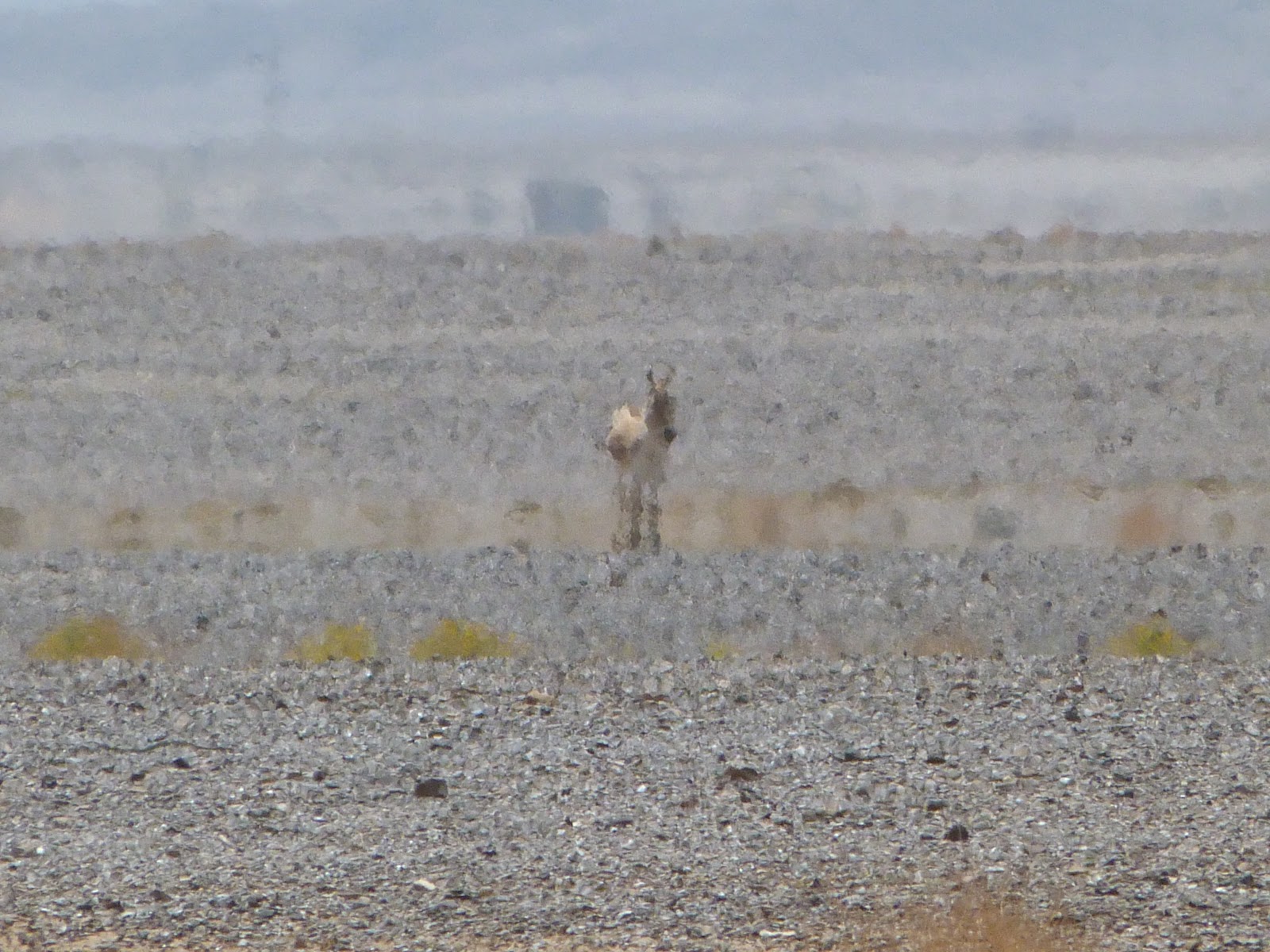
Wild ass in the heat haze
Sometime later and after a long
walk, I eventually found a couple of Temmick’s Larks foraging amongst some
yellow flowers in a wide wadi.

Temminck's Lark
No more than five minutes later Chris finally tied down the
Thick-billed Lark.
It was after 2pm by the time we reached Shivta Junction with
its café and garden. The cool drink and ice cream was very welcome, as was the
Hume’s Warbler, present for over a month and looking distinctly worse for wear
as it had begun to moult.
We then had a check around the nearby sewage works, not much
to see there and certainly not worth enduring the stink! The KM20 pools held
nothing new so we were back in Eilat just 12 hours after we set out.
30th March
It was just Carmelle and us today. It wasn't particularly busy, but the temperature soared as the day progressed. We had 110 or so birds including a couple of Wryneck, some Eastern Orphean Warblers and a Redstart. Chris also hand caught a Little Green Bee-eater.


We didn't go straight out after ringing as it was just too hot. We tried the South beach at about 4pm - no sign of the Brown Booby, a bird that had been taken into care and recently released. We then went to an unusual location where a Little Bittern has made itself at home.


30th March
It was just Carmelle and us today. It wasn't particularly busy, but the temperature soared as the day progressed. We had 110 or so birds including a couple of Wryneck, some Eastern Orphean Warblers and a Redstart. Chris also hand caught a Little Green Bee-eater.

Green Bee-eater

We didn't go straight out after ringing as it was just too hot. We tried the South beach at about 4pm - no sign of the Brown Booby, a bird that had been taken into care and recently released. We then went to an unusual location where a Little Bittern has made itself at home.

Little Bittern male
See below for the location of the Little Bittern, a round-a-bout (with water and waterlilies) on the road to Egypt.

We walked Holland Park but there was nothing new and a strong wind was blowing from the East, picking up sand, clouding the air. Then at the North beach we saw Collared Pratincole, 5 Sandwich Terns, 18 White-eyed Gulls and a Caspian Tern.

Sunset over the Eilat mountains

 Common Crane
 Kentish Plover
 Little Stint
 Greenshank

 Striated Heron
 Laughing Dove


 Seams of Copper ore run through the rocks and this site has one of the first known mines


 The mushroom


31st March
There were a total of 137 birds ringed today, an event for photographers so they were on site from 6am, and also 4 groups for talks about the sanctuary and birds. There was nothing out of the ordinary from the nets.

Eastern Orphean Warbler
Nets were closed at midday and we decided to go to Timna Park via the KM20 pools. We had our first White Stork actually on the ground and a Common Crane.


Ruff
At Timna Park we looked at some if the stone paintings and rock formations, finishing off at the oasis, where the lake had attracted some migrants including Collared Flycatcher, European Kingfisher and Striated Heron.


European Kingfisher
The geology was also fantastic.


The arches


Brown-necked Raven