Monday, 9 November 2015

Gedser Fuglestation - 9 November 2015

Adverse weather again - strong winds after much rain during the night. We managed to open enough nettage for a standard session, choosing the most sheltered nets next to vegetation where most of the leaves were already on the ground, but the large numbers of thrushes and finches reluctant to migrate in the conditions stayed high and most avoided the nets.

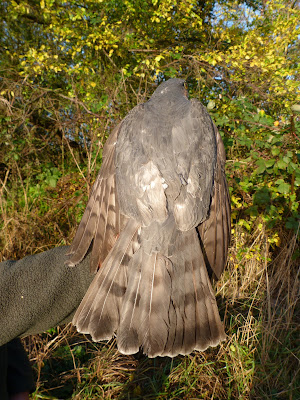
The first two birds of the day were a couple of 2nd winter Sparrowhawk (Spurvehøg). These were interesting to compare as they were moulting their feathers in slightly different sequences.

 First 2nd winter Sparrowhawk male (2k Spurvehøg han)

 New secondaries, retained primaries.

 One outer tail feather, on each side, retained.


 Second 2nd winter Sparrowhawk male (2k Spurvehøg han) with
head and breast looking more adultlike than first bird.

 Tail moult less advanced - total of six retained retrices

After standand we tried some sound and attracted some Redpoll before the point in the afternoon where the garden was seemingly lifeless, three rounds had produced nothing and nets were closed with no prospect of opening after dark due to the strengthening wind.

However, one of the Lesser Redpoll (Lille Gråsisken) had a golden rather than red poll. This is quite unusual and may be due to a dietry deficiency although the precise cause is unknown.

 Juvenile Lesser Redpoll (1k Lille Gråsisken)


Totals: 35 (3)
Spurvehøg / Sparrowhawk -3
Rødhals / Robin - 0 (1)
Fuglekonge / Goldcrest - 6 (2)
Bogfinke / Chaffinch - 2
Grønsisken / Siskin -6
Nordlig Gråsisken / Common Redpoll - 5
Lille Gråsisken / Lesser Redpoll - 11
Stor Dompap / Northern Bullfinch - 2

Sunday, 8 November 2015

Gedser Fuglestation - 8 November 2015

The rain and wind overnight were terrible so there could be no ringing until the wind calmed. We had a lazy start on this Sunday morning and, after breakfast, Chris went to the tip where he enjoyed watching the passage of Common Buzzard and Sparrowhawk.

I hadn't fail to notice the numbers of Buzzard and Sparrowhawk drifting above, or hurtling around the house on a couple of ocassions, so decided that by 10am it should be possible to drop the large mesh nets on the lawn. I arrived to find one net down due to a peg having pulled out - that really had been some bad weather last night! So, only one net was dropped while I returned to the house for some cord to get the second net properly secured and back in working order. The first  Sparrowhawk    (Spurvehøg), a big female that weighed in at 291g with wing length of 249mm (that's only the measurement from the carpel joint to feather tip) was already in the net when I got back.

When she had been processed I went back to do my net maintenance and had only just completed that when the first net check found another captured female Sparrowhawk, this time an adult

I had just finished collecting all her data when Chris got back so we were able to photograph her before release.

 Adult Sparrowhawk female ( 2k+ Sparrowhawk hun)


With the wind a little less strong now, Chris opened a few very sheltered nets and used an audiolure for Goldcrest (Fuglekonge), we only got a couple (and there were technical difficulties as the MP3 player kept turning off) so we tried a different player and played Redpoll (Gråsisken) later in the afternoon. There was a bit more success from that - the Redpolls even brought a few other finches with them.

There were a couple more Sparrowhawks, this time much smaller males, but the birds that had been hunting in the strong winds of the early morning had disappeared by mid afternoon. Many probably migrated as Chris had seen about 20 birds leave from the tip in the short time he was there.

 Juvenile male Sparrowhawk (1k han Spurvehøg)


Totals:21 (5)

Spurvehøg / Sparrowhawk - 4
Rødhals / Robin - 0 (2)
Solsort / Blackbird - 0 (1)
Fuglekonge / Goldcrest - 2 (2)
Musvit / Great Tit - 0 (1)
Grønirisk / Greenfinch - 2
Tornirisk / Linnet - 1
Nordlig Gråsisken / Common Redpoll - 1
Lille Gråsisken / Lesser Redpoll - 11

Saturday, 7 November 2015

Gedser Fuglestation - 7 November 2015

We were keen to complete standard ringing today as we only have a week of our migration monitoring at Gedser Fuglestation remaining. Added to that, the wind forecast for tomorrow looks nigh impossible for morning ringing - and there was no ringing yesterday due to persistent rain.

We were up in time to drop nets well before first light but delayed our start as the rain had not quite cleared as the forecast indicated it would. When the time came to drop nets there were some nets that were too wind effected to use but we still had enough for standard and also deployed the large mesh sparrowhawk nets.

The species count was low but we finished on 80+ birds, mainly Fuglekonge (Goldcrest) and Siskin (Grønsisken) but thanks in part to some good afternoon captures of  Lille Gråsisken (Lesser Redpoll) with the assistance of audiolures.

  Gråsisken hun (redpoll female) 

 Gråsisken han (redpoll male)

Totals: 86 (8)

Spurvehøg / Sparrowhawk - 1
Gærdesmutte / Wren - 4
Rødhals / Robin - 13 (1)
Solsort / Blackbird - 3 (1)
Fuglekonge / Goldcrest - 27 (5)
Blåmejse / Blue Tit - 0 (1)
Musvit / Great Tit -0 (1)
Bogfinke / Chaffinch - 1
Grønsisken / Siskin - 20
Lille Gråsisken / Lesser Redpoll - 14
Stor Dompap / Northern Bullfinch - 3


Gedser Fuglestation & birding in Lolland - 5 November 2015

There was rain at our usual time to set the nets and as the radar showed more rain at 9am we did not try for standard ringing this morning. When the rain had stopped we went out to take a look at our new noisy neighbours. It was difficult to estimate numbers but they certainly were enjoying what remained of the sugar beet, recently harvested.


There was clearly a new influx of Goldcrest (Fuglekonge) so we dropped just two nets and kept a very close eye on them in the rather cold wind. We were catching for approximately 75 minutes during which time there were no retraps.

We were going to be taken after the standard ringing session by Gert, one of the guys that helps run the observatory, over to Lolland to do some birdwatching around the lakes there, but as we were not able to start within the alloted time frame, we set off with him as soon as he arrived.

The lakes held high numbers of dabbling duck, Great Crested Grebe, large flocks of Greylag, White-fronted, and slightly fewer Barnacle Geese, diving duck, including Red-crested Pochard, a few Smew, the first of the winter arrivals and a couple of Great White Egrets. The lakes are a breeding area for Red-necked Grebe, which are absent in winter, hence we saw none here! White-tailed Eagles breed here and we had one in flight about 2.30 pm, from which as it was followed over into the woods, Denise picked up three unidentified day time flying bats.

Søndersø

 
  White-fronted Geese

Common Goldeneye


Røgbølel Sø

Chris, & Gert who we thank for showing us another
part of Denmark, and an area that he particularly 
enjoys visiting for duck and geese in winter.

Wednesday, 4 November 2015

Gedser Fuglestation - 4 November 2015

For anyone who missed the update on yesterday's blog - we did a second Tengmalm's Owl (Perleugle) last night. This bird had flight feathers of all the same age so it is a bird hatched this year.

 
 Tengmalms Owl Age 3 (Perleugle 1k)

 
After 5 hours trying for owls last night, with one caught and a second bird seen on a hawthorn bush close to nets, it was a very cold morning as we both found out when we dropped the nets before dawn. A bit later as we did our first round, it was to what sounded like a fanfare played on toy trumpets, by players who really needed some practice. From the repeated, monotone call, we knew that a small flock of Northern Bullfinch (Stor Dompap) were moving through the site. As well as being larger in size than either of the two species found in Denmark or the UK, they also have a louder and quite distinctive call. Four individuals were captured throughout the morning, all being first year (1k) birds.

 Northern Bullfinch juvenile male (Stor Dompap 1k han)

 Northern Bullfinch juvenile female (Stor Dompap 1k hun)

The Sparrowhawks (Spurvehøg) juveniles we are seeing now include a morph different to the rufous ones seen in September and October.

 Juvenile female Sparrowhawk (1k hun Spurvehøg) with black and white colouration.


 Rufous colouration on two different individuals for comparison.


There were a lot of recaptures today, one being TM4755, a Goldcrest (Fuglekonge) with a Swedish ring.

Flocks were again seen heading for the tip intent on making the crossing. A large flock of Barnacle Geese (Bramgås) were feeding on the beet field just north of the observatory at the end of the day. There is rain forecast for the next two days so we shall wait to see whether ringing is possible.

Totals:  37 ( 29 )

Spurvehøg / Sparrowhawk - 2
Gærdesmutte / Wren - 1
Jernspurv / Dunnock - 1
Rødhals / Robin - 3(6)
Solsort / Blackbird - 2 (3)
Sangdrossel / Song Thrush -0
Munk / Blackcap - 0 (1)
Fuglekonge / Goldcrest - 5  (15)
Rødtoppet - Fuglekonge / Firecrest - 0 (1)
Blåmejse / Blue Tit - 1 (1)
Musvit / Great Tit - 4 (2)
Bogfinke / Chaffinch - 1
Grønsisken /Siskin - 11
Lille Gråsisken / Lesser Redpoll -2
Stor Dompap / Northern Bullfinch - 4

Tuesday, 3 November 2015

Gedser Fuglestation - 3 November 2015 - update 2nd Tengmalm's Owl

This morning was misty and cold. A few flocks were moving overhead but several, including a flock of circa 70 Sjagger (Fieldfare) did not migrate, instead staying in the local area although rather restless. None of the finch flocks or the Sjagger (Fieldfare) were very interested in the ringing garden and during standard we had to be content with mainly Fuglekonge (Goldcrest) and Rødhals (Robin).
Once standard ringing finished we could use audiolures and just one Sjagger (Fieldfare), the third for the year, was captured. This bird has small black centres to the grey feathers on the head indicating that it is a female. A second indication is that the tail feathers are dark brown rather than black.

 1k hun Sjagger (1st year female Fieldfare)


We also tried for Grønsisken (Sisken) and Gråsisken (Redpoll), attracting both species and some Kværkefinke (Brambling).

1k han Kværkefinke (First year male Brambling). 

The yellow axillary feathers can only be seen (with difficulty) when the bird is in flight.


Our daylight ringing was completed with the capture of four Gulspurv (Yellowhammer) coming in to roost.

2k+ han Gulspurv (Adult male Yellowhammer)


 We are still playing for owls most nights, but had no success last night.
We caught our second Tengmalm's Owl (Perleugle), a first year bird at 20:30 tonight.


Totals: 80 (30)

Perleugle / Tengmalms Owl - 1
Gærdesmutte / Wren - 1 (1)
Rødhals / Robin - 20 (8)
Sjagger / Fieldfare - 1
Solsort / Blackbird - 0 (5)
Sangdrossel / Song Thrush -0 (2)
Gransanger / Chiffchaff - 1
Fuglekonge / Goldcrest - 31 (10)
Rødtoppet Fuglekonge / Firecrest - 0 (1)
Musvit / Great Tit - 0 (2)
Kværkefinke / Brambling - 7
Grønsisken /Sisken - 13
Lille Gråsisken / Lesser Redpoll -2
Gulspurv / Yellowhammer - 3 (1)

Monday, 2 November 2015

Gedser Fuglestation - 2 November 2015

A very slow morning in extremely calm conditions. Towards the end of standard ringing we began to catch Fuglekonge (Goldcrest) without rings, so it seemed that there had been another small influx of what has been our most numerously caught bird this autumn.
We did some late afternoon ringing with the help of audiolures, but only succeeded in getting a few more Fuglekonge. At dusk we switched our efforts to catching owls again, playing a mixed tape of Perleugle (Tengmalm's) and Sanglærke (Skylark) calls. The first check of the nets revealed that a Sanglærke (Skylark) had been drawn to the tape and captured.

1k hun Sanglærke (Adult female Skylark)

Standard ringing produced singles of Lille Dompap (Bullfinch), Lille Grå Sisken (Lesser Redpoll), Munk (Blackcap) and Gransanger (Chiffchaff ). There have been a few days without the last two species, could these be the last of the season?

Could this be our last Gransanger of the year?

We are currently still trying for owls and will update you on our progress tomorrow.


Totals: 43 (15)

Spurvehøg / Sparrowhawk - 1
Sanglærke / Skylark - 1
Gærdesmutte / Wren - 0 (1)
Rødhals / Robin - 5 (3)
Solsort / Blackbird - 1 (5)
Sangdrossel / Song Thrush - 1
Vindrossel / Redwing - 2
Mink / Blackcap - 1
Gransanger / Chiffchaff - 1
Fuglekonge / Goldcrest - 27 (5)
Rødtoppet Fuglekonge / Firecrest - 0 (1)
Bogfinke / Chaffinch - 1
Lille Gråsisken / Lesser Redpoll - 1
Lille Dompap /Bullfinch - 1