Monday, 19 May 2014

Chobham Common - 19 May 2014

We meet up with Richard Denyer am to check out primarily a Chiff-chaff nest we had located a few days earlier, but we unfortunately found it had been predated. We then checked an open area and a majority of the Sky Larks appeared not to have young yet, as only one was seen carrying food, and despite the presence of adult Lapwings we could not locate any young.

Richard headed off, and after the usual cafe visit we returned to walk the south side of the common looking for Dartford family parties, but with a warm middle of the day and a brisk breeze we only located Dartfords in one area and failed to have any success. Whilst chatting to one of the wardens whom we bumped into during our amble, he advised us that one of the other wardens had seen two Lapwing chicks, so before heading home we went to the area again and this time after about half an hour managed to locate two chicks, but only managed to keep track of one, which was rung.

Lapwing Chick

Total: 1

Lapwing 1

Noar Hill and Oaken Wood - 18 May 2014

We have not made any real Butterfly excursions this year and this was really the first one. Initially we stopped off at Noar Hill, mainly for Duke of Burgundy, which were seen in reasonable numbers, along with Dingy Skipper, Brimstone and Green Hairstreak, plus a few fresh Small Heaths.

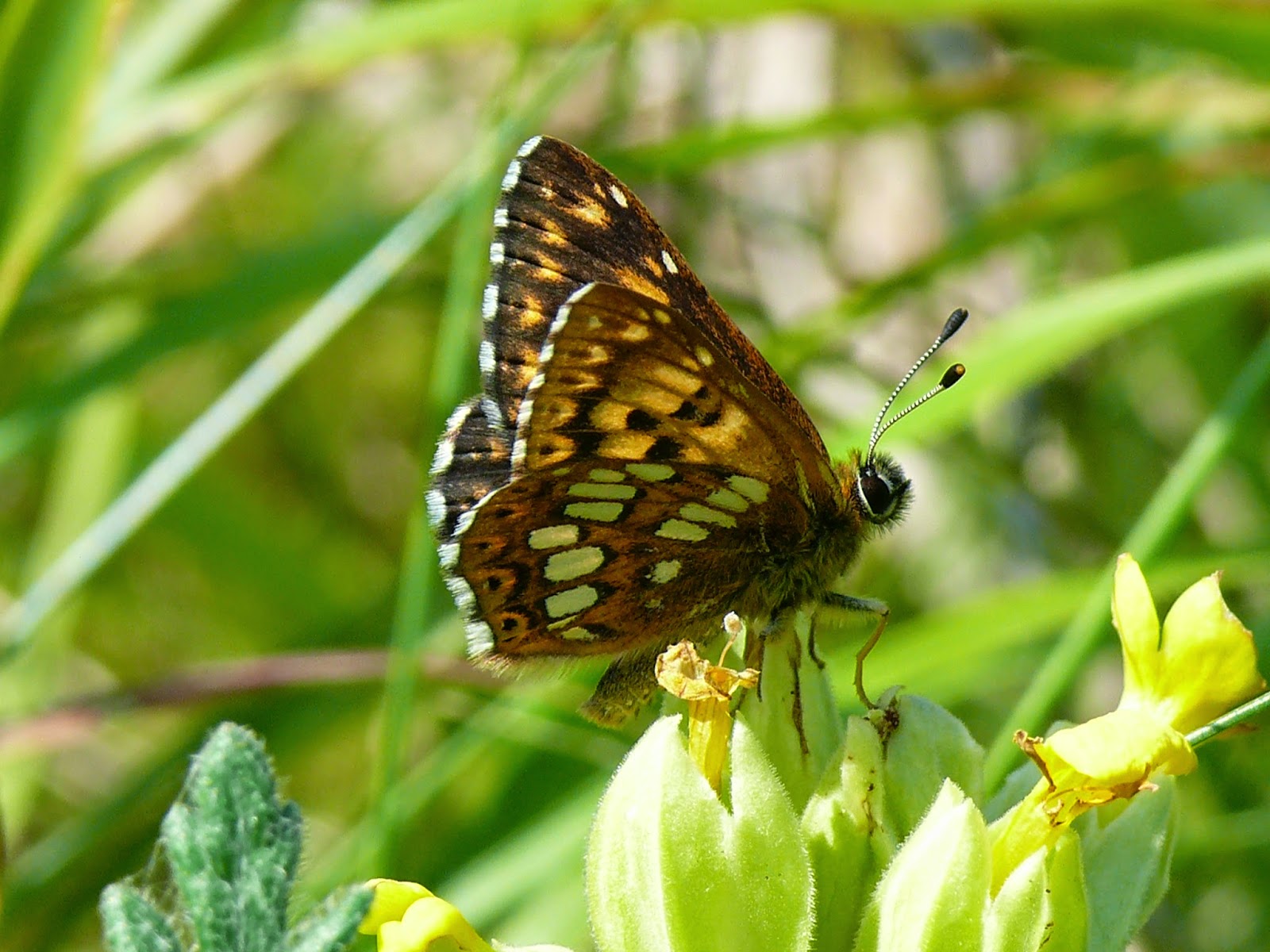
Duke of Burgundy


Green Hairstreak


Dingy Skipper

Small Heath

After a couple of hours at Noar Hill we headed over to Oaken Wood, where despite the first Wood White having been seen at the beginning of the month, few were seen, with only a total of three in evidence.

Wood White


Saturday, 17 May 2014

Broadwater GP - 17 May 2014

A visit by CL, DKL, MRB and Margaret found the site bathed in sunshine with minimal breeze. The usual number of nets were erected and we began to catch, mainly a steady trickle of breeders and in the case of the Robins some of the ofspring too.

3JJ Robin

There were 18 birds all told with a few examples of adult birds already starting their summer complete moults. The best bird of the day was, unfortunately, not caught. A Wood Warbler was heard to emit brief bursts of song up until 9.45am or so, but despite efforts to locate it in the canopy, it never emerged into view and was not seen.

Totals:
Great Spotted Woodpecker - 0 (1)
Robin - 7
Blackbird - 3
Song Thrush - 2
Blackcap - 3
Chiffchaff - 1
Blue Tit - 0 (1)

London Wetlands Centre - 16 May 2014

This afternoon we were invited to join WH at the London Wetlands Centre ( that is unrecognisable as the reservoir complex where we birded many years ago) to monitor the Sand Martin colony. This was his second visit of the breeding season. The manmade colony in constructed of pipes leading to sand filled chambers, four rows of 25 although some units are blocked up and other cells are solid breeze-block. Each unit has a separate wooden back secured with two metal latches.

A22 contained 4 chicks

Many of the boxes are still empty but 3 held families of 4 that were big enough to ring. Some cells showed signs of nesting activity with prospecting adults in the pipes, others held up to 5 eggs. More nests with very small chicks should have ringable young by the next visit in 10-14 days.

One of 12 Sand Martin chicks that were ringed

The nests consist of a depression formed in the sand
with dried grass, sticks and feathers.

External colony wall

Throughout the monitoring operation adults continued to come and go as usual.

Many thanks to WH for allowing us this fantastic opportunity. We really enjoyed the afternoon.

Dinton Pastures CP - Lavells Lake CES - 15 May 2014

Whilst D was busy working I joined TA and a couple of his trainees at Lavells Lake CES site. I have visited Dinton pastures CP several times, but this is the first time I have been to Tim's ringing site, which is behind Lavells Lake, and I was quite impressed with the potential the area has to ring in. It had the feel of having quite a bit of potential in the autumn migration period, especially for Sylvia Warblers. Tim's CES is not especially large, but it ticked over quite well, producing 25 new birds and 9 re-traps.

There were a few Damselflies around to fill a little of the time between rounds.

Banded Demoiselle - female (above), male (below)

 
 Red-eyed Damselfly - female

Common Blue Damselfly
Total: 25 (9)
                  
Wren 1 (1)
Dunnock 4 (2)
Blackbird 1 (1)
Cetti's Warbler 0 (1)
Reed Warbler 6 (2)
Garden Warbler 0 (1)
Whitethroat 1 (0)
Blackcap 5 (0)
Blue Tit 2
Great Tit 2 (1)
Longtailed Tit 2
Bullfinch 1 

Monday, 5 May 2014

Chobham Common - 5 May 2014

Today we met up with EP to work the cattle enclosure before the animals are introduced to the common at the end of the week. We went knowing that the wind was likely to get up by 10ish giving up about 3 hours netting time before we would probably have to take down.

We knew that the catch total was likely to be low, but with the possibility of Tree Pipit, Wood Lark, Stonechat, Cuckoo and Dartford Warbler, if was still worth making the most of the opportunity.

Our first bird was a humble Great Tit, slightly surprising as it turned up in the middle of a sizable, open area. The next bird was a Stonechat, as was the next, and the next, and the next. Well, if you're going to have a 'samey' catch, you might as well make it a quality species. No luck with the other species that were all seen, but sadly not caught. How often is Stonechat the leading species?

5M Stonechat showing moult boundary below


5F Stonechat


Second 5M with OGCs

Second 5F with distressed primaries and secondaries - right wing only
This bird was desperately in need of its next summer complete wing moult.

Total: 5
Stonechat - 4
Great Tit - 1

Saturday, 3 May 2014

Broadwater GP - 3 May 2014

An improvement on our visit last week. Definitely heard more birds and also saw Buzzard, Red Kite and the first Hobby of the year overhead. We had some time to find a few more promising locations for nets and made a total of 19 captures with nearly half of these being retrapped birds. We were most pleased to recapture Garden Warbler Y195989 that had been ringed on 27 May 2013.


It's amazing to think that this bird has been to sub-Saharan Africa and back since we saw it last.

As usual, the resident birds were well represented. We caught this rather smart Bullfinch in exactly the same place as we got a female last time. Probably a pair and perhaps we'll catch up with their offspring soon.

5M Bullfinch

Total: 11 (8)

Wren - 3 
Dunnock - 0 (1)
Robin - 2 (2)
Song Thrush - 1
Blackbird- 1
Garden Warbler- 0 (1)
Blackcap - 2
Long-tailed Tit - 0 (2)
Blue Tit - 1
Great Tit - 0 (1)
Jay - 1
Bullfinch - 1