Tuesday, 28 November 2023

A farm in North-west Norfolk - 28th November 2023

 The first ringing session of the winter provided data on 47 birds. We were unable to place nets in the same places as last year as the vegetation has not died back as much as it did last year, also the winter bird crop has done much better and whereas we could put nets up on the very short plants, this year the vegetation is almost a metre high. Thankfully we were not constrained by winter CES and could site nets in alternative positions.

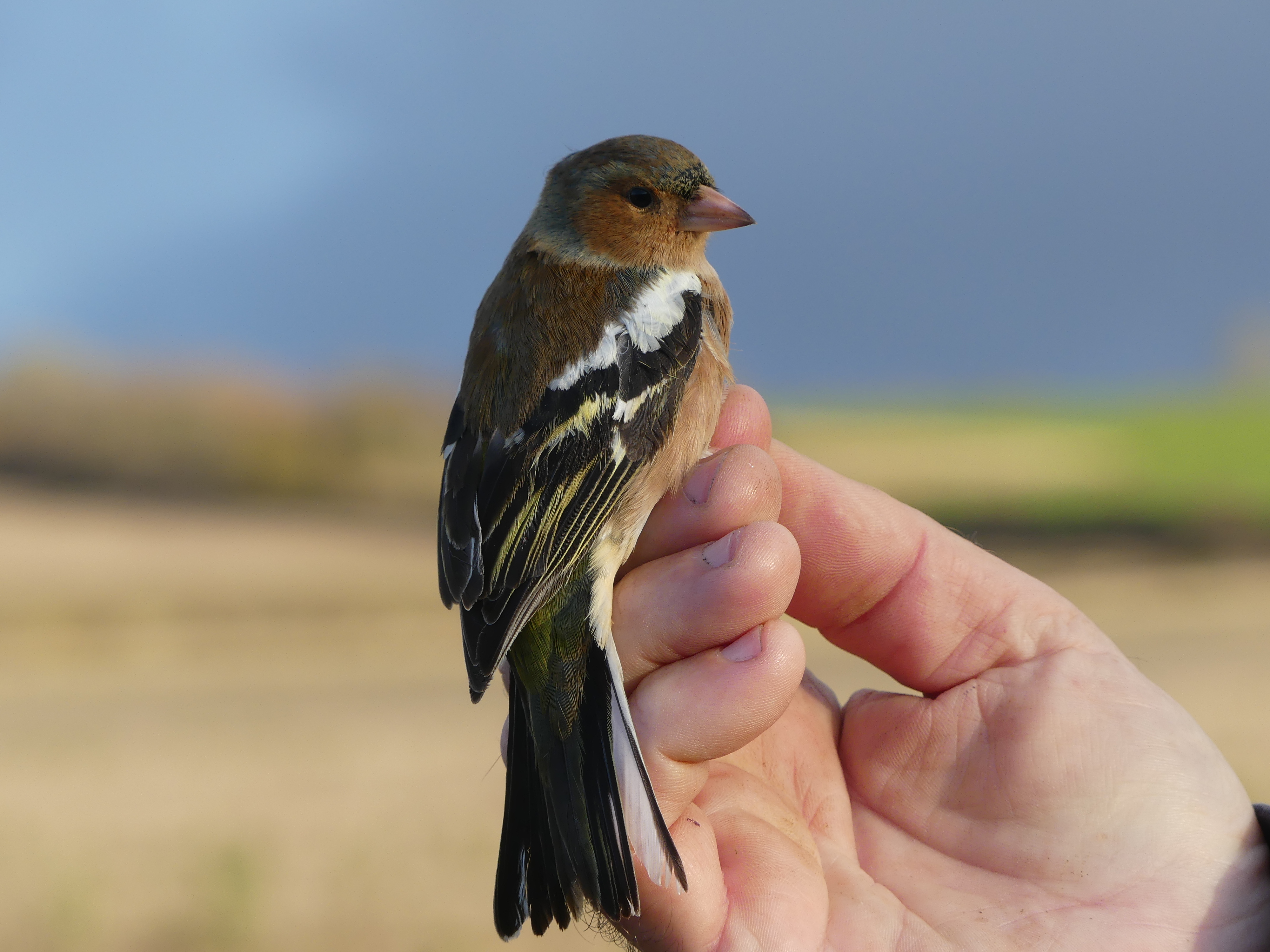
A double placed in the orchard by the farmhouse did not provide the expected Blackbirds, instead trapping rather too many tits for our liking. There were 10 Blackbirds from field side nets but only 4 Chaffinch. 

Male Chaffinch, 4 ringed and one released unringed due to foot infection.

Juvenile Redwing

Juvenile Marsh Tit - we should soon receive the coded 
darvics and start the new Marsh tit project.

Total: 46 (1)

Wren - 1
Robin - 2
Dunnock - 8 (1)
Blackbird - 10
Redwing - 1
Blue Tit - 15
Great Tit - 4
Marsh Tit - 1
Chaffinch - 4

Sunday, 26 November 2023

A farm in North Norfolk - 26th November 2023

 The change back to chilly UK winter temperatures was a bit of a shock to the system after last week's stay in Gibraltar when afternoon temperatures reached 26degrees. It was a little breezy but not too chill until after mid-day when the wind began to get up across the farmland.

We had planned for a larger team that didn't materialise but still erected the planned 10 nets.

There were a lot of birds on site, making the most of the areas planted specifically for wild birds. Reed Bunting was well represented in the birds observed with lower numbers of Yellowhammer,  Chaffinch and Blackbird and we were quite pleased with a catch nearing 70 birds.

3M Reed Bunting

4M Yellowhammer

Juvenile Dunnock

We are hopeful that this site is attractive to birds migrating south to avoid the worst of the winter weather in mainland Europe and will turn up some foreign controls in the fullness of time.

Total: 67 (2)

Robin - 4 (2)
Wren - 2
Dunnock - 11
Blue Tit - 14
Chaffinch - 3
Reed Bunting - 32
Yellowhammer - 1


Gibraltar Ornithological and Natural History Society - 12th November -23rd November 2023

 Our first time at the rock, we were rather surprised by how urbanised the land around the rock is with several areas expanded via reclamation. We were staying at the observatory building at Jews Gate, a building that was used as a jail during WWII, hence the bars across the windows.

 The building is in a busy location with groups of tourists arriving throughout the day to view the strait and Mount Hacho across the water in Morocco. Together with the Rock pf Gibraltar these are the pillars of Hercules. In Greek mythology the pillars represented the limit of the known world.

MAC, the ringer in charge and who we've ringed with before, in Kenya, showed us around the site's upper and lower 'gardens'. The rides of some nets were quite difficult being on slopes, with trip hazards and some loose debris.


Over our time there, we had an average of 80 birds or so each day. The 21st was entirely lost due to strong westerlies that made opening up impossible. A full list of captures is available on the following link.

https://www.gonhs.org/news/latest-bird-sightings/241-recent-sightings-november-2023

Being rather late in the season we had quite a narrow range of species, but we did get in hand experience of a new species as Crag Martins often flew close to the nets in the early evening.

Ageing principle similar to Sand Martin although most juveniles
were not as well marked as the individual on the right. Bird on left is an adult.

There were waves of Black Redstart arriving with some seen around the building on most days.


We caught a few Serin.

There were even fewer Greenfinch.

Record numbers of Siskin were passing through the site as unusually high numbers 
of the small finches headed south via Gibraltar

Blackcaps were a regular capture. The only control during our time there was of a female Blackcap with a ring from Gdansk, Poland.

Adult female Sardinian Warbler

There was a single Long-tailed Tit and a few Blue Tits, quite different to the UK birds as the dull green panel on juveniles looks extremely dark green on the few examples seen.

The numbers were boosted by the use of playback. In addition to the three players belonging to GONHS we had taken another three and MAC had taken some of his own too. 

Birds tend to get caught moving up or down the rock. Here are some examples of the net rides.
 
Net 17 on two levels with the bottom line between pipes 
and next step up at shoulder height.

Net 18 (high net) sloped ride with ropes to hopefully prevent slips and falls

Net 20 

It is possible to stay and ring with accommodation cost of £10 per night. The room we had was quite basic. You need to supply your own food and it's quite a walk to reach supermarkets in the town. We were surprised by the low catch numbers in September and October - but the odd interesting surprise is always possible.

Barbary Partridges 

Macaques spend a lot of time grooming and generally 
keep to themselves if people respect their space.

Wednesday, 8 November 2023

A farm in North Norfolk - 7th November 2023

 The winters of 2021 and 2022 demonstrated how difficult it can be to ring farmland sites in the very windy conditions that prevail for much of the time here in Norfolk, making any structured approach such as winter CES near impossible. We already have a couple of farms where we may ring, however the fields are large and ringing days are often ruled out as the wind makes use of mist nets impracticable. Having made an approach to a local farmer, sympathetic to the needs of conservation, with good numbers of buntings on his fields we were recently taken for an on site reconnaissance and were granted permission to ring on the site.

The conditions were not ideal and the wind gusts increased beyond the speed forecast, but today we went on site to assess how the birds use the site, see what lines they take and generally consider where nets might work well. There were fewer birds about than when we had driven round before but we still identified three key areas where nets could be placed between hedgerows and the head height wild bird crop. We put up singles in the three locations where doubles or triples could be fitted in on a calmer day.

The nets were wind affected but that didn't prevent a catch of 29 birds. Looking very promising for the 2023/4 winter season. Many thanks to the land owner for agreeing to work with us.

Reed Bunting, leading species 13 of 29

Male Yellowhammer

Total: 29

Robin - 2
Dunnock - 5
Blue Tit - 3
Greenfinch - 1
Reed Bunting - 13
Yellowhammer - 5


Wednesday, 1 November 2023

Deepdale Farm - 1st November 2023

 An unexpected return to the farm. The wind was rather too strong for general mist netting, but the mass arrival on the coast was of Blackbirds, and these being fairly heavy birds we thought there could be some scope to catch a few at Hilly Piece.

The wind was rather strong and many birds saw the nets, however we still managed to catch 16 over the course of a couple of hours in the early afternoon. despite a few breaks for rain as the squalls passed through and nets were closed.

3M Blackbird

It was great to catch what were clearly the continental race of Blackbird. Notable were a female  with tail appearing black rather than the expected brown, and a male with 142mm wing, checked by CL to confirm and definitely a Blackbird.

Total: 17

Blackbird - 16
Song Thrush - 1 

Observation of Crossbill, Hen Harrier, Peregrine and a flock of Pink feet over the farm.

Tuesday, 31 October 2023

Deepdale Farm - 31st October 2023

 A last try for Meadow Pipits passing through on passage confirmed that numbers have decreased considerably. In a short session, curtailed by rain showers that started earlier than the forecast predicted there were no Meadow Pipit captures, although birds were seen both feeding on the sodden stubble and seeing off a Short-eared Owl that flew east along the sea bank.

Reed Buntings continue to use the uncut portion of the area, with some captured before the rain. A Stonechat was a the first that we've ringed on the marsh fields.


Total: 10

Stonechat - 1
Blue Tit - 2
Reed Bunting - 7

Sunday, 29 October 2023

Wreck of European Shag - October 2023


Juvenile Shag ringed and released on 27th at Wells-next-the-sea

The week of the 23rd of October saw some unusual movements and sightings of European Shag. The unusual behaviour may be linked to Storm Babet (weather warnings issued for 18th to 21st October) that led to the most severe and widespread weather impacts of this year so far. 60+ shag were recorded heading south, offshore of Saltfleetby/Theddlethorpe Dunes on Monday 23rd with a further report, from Spurn, of 226 birds headed south. The twitter post by John Hewitt refers to birds "just plonking down anywhere they really shouldn't".

undisclosed car park

Two Shags resting at ponds, Spurn 

Report of a ringed bird in bins at Peterhead, Aberdeenshire by Paul Reynolds.
Ringed in Edinburgh. Flew off unaided.

On the 25th, David Steel posted about the unusual places that storm driven birds may turn up, and posted a brief video from the old lighthouse engine room on the Isle of May.

https://twitter.com/SteelySeabirder/status/1717165828183834631

This bird was successfully released to the sea the following day.

A tweet by R.Stephenson on the 25th referred to a bird found 30 miles inland at Bolton on Swale Gravel Pit.

European Shag, R Stephenson

On the 25th we were monitoring for pipits in the marsh fields at Deepdale Farm, Burnham Deepdale, Norfolk and were sent this interesting image of Shags on the farm topper. They appeared to be looking for something to eat as the tractor worked the field. Their appearance away from the sea seemed to be linked to the dense sea fret we were experiencing at the time.

Deepdale tractor attracts three juveniles

The farm staff saw all three birds fly into a hedge and on our advice, that they may not be able to get airborne, tried to find them later that day and on the day following but there was no trace. 

Our post on Twitter of the shags at the farm attracted a lot of attention, including a request to look out for colour ringed birds. There had already been some other odd reports including one bird that tried to enter a house in Nottingham and another that was in a garden in Lincolnshire.

A report of a dead bird with darvic RAX at Easington Lagoons showed that being forced inland is a risky business, leaving birds extremely vulnerable even when they are able to find a body of water.

RAX, ring on the Isle of May, June 2023 Entangled in wire mesh

Other reports on the 26th included four birds photographed in a park in Sheffield.

Photo by Tony Holme

Dan Martin's image of two of the four birds showed a darvic ring RZW.

The ringed bird had been ringed at the nest on the Isle of May in June.

By the 27th three birds were showing at Hykeham Pits and other reports of single birds from a smattering of locations. We got a call from Estelle at Deepdale Farm to say she had found a Shag walking down the farm road. Continuing in that direction leads to the coast, but it's quite a distance for webbed feet and involves crossing the main coast road. Estelle picked the bird up and called us after getting it safely into a box.

It wasn't long before we arrived there, making another check for the birds seen on Wednesday, before taking it to the quay at Wells-next-the-sea where the tide was coming up.

The bird was keen to return to the water and began feeding and drinking immediately.

Back in a familiar environment

The following day there was a report of 4 Shags in the channel at Brancaster Staithe, only about half a mile from Burnham Deepdale. Perhaps the three tractor travellers plus the one we took to Wells have reunited.

3 of 4, taken by Tom Lowe at Brancaster Staithe