Thursday, 10 June 2021

Staines Moor & Langham's Pond, Runnymede 2nd June 2021

The visit to Staines Moor was to carry out the final Breeding Waders of Wet Meadows project survey, which again, possibly due to the high grass height failed to produce any proof of Lapwing breeding. There was the start of a good emergence of Banded Demoiselles on the River Colne.

Banded Demoiselle

Afterwards a check at the pond at Runneymede was carried out as this site has previously had Variable Damselfly reported there, a species not overly common in this area. Alas, none were seen but Odonata species were more varied today with Common Blue, Azure, Blue-tailed, Red-eyed and Large Red Damselflies seen, seven Hairy Dragonflies, three Broad-bodied Chasers, single Four-spotted Chasers and a single Downy Emerald. 

Azure Damselfly

Hairy Dragonfly (female)

Large Red Damselfly

Blue-tailed Damselfly

Broad-bodied Chaser


Chobham Common - Odonata 1st June 2021

 A visit to our usual three Odonata ponds, again like the previous day due to the poor May were relatively low on the variety of species in abundance present. 

The first pond near the M3 apart from a couple of common Damselfly species had six fairly fresh Four-spotted Chasers and at least two Downy Emeralds, but nothing more than this.

The next two ponds near the golf course due to last year's fire are now completely out in the open with no surrounding vegetation. There were in addition to the species seen at the first pond a few Red-eyed Damselflies, a single Hairy Dragonfly and at least four Downy Emeralds on both ponds.

Downy Emerald

Four-spotted Chaser

Red-eyed Damselfly


Barred Grass Snake

The pools by the golf course seem to be a favoured area of them.

Braddenham Wood & Hedgerley (Wapsley Wood) landfill - 31st May 2021

A visit to the clearing at Bradenham Wood where there has been a Duke of Burgundy re-introduction project on-going to have a quick check of the site. This is a north facing slope, and whether this has an effect or not, the Dukes tend to be more a mid-May emergence population at this site. We managed to locate a single and the only other notable species were a couple of Green Hairstreaks and Dingy Skippers. A singing Willow Warbler was a pleasant accompaniment during the time spent there.

Duke of Burgundy


Green Hairstreak

Dingy Skipper

Willow Warbler

In the afternoon a visit was made to one of the shallow pools on the edge of the old Hedgerley sand pit, which whilst a nice Odonata site is next to the M40 and a little noisy. Due to the poor weather in May the site was a little quiet still with only Azure and Large Red Damselflies present along with a few recently emerged Four-spotted Chasers.

Four-spotted Chaser

Friday, 4 June 2021

Bentley Wood & Martin Down 30th May 2021

Finally the dreadful weather has passed and we got a decent day to go out for dragonflies on the bank holiday weekend. We started off at Bentley Wood for Pearl-bordered Fritillaries.

It was quite wet underfoot and the Bluebells seemed to be well behind the
carpets of blooms that we've seen in some woods.

Broad-bodied Chaser

We were on site before the butterflies became active, and the hares 
didn't move off until more visitors came to look for the butterflies.

We saw very few Pearl-bordered Fritillaries compared to what had been present last year. 

Horsetails

Argent & Sable Moth

We quickly moved on to Martin Down (mainly as we were concerned about being able to park).

Martin Down holds some interesting species that are found on chalk down land.

Marsh Fritillary

Marsh Fritillary

Marsh Fritillaries are one of the site specialties. We are always amazed at how these are limited to a very specific few metres of one of the dykes. We were fortunate to find several.

Brown Argus

Green Hairstreak

Nuptial pair of Small Blues

Toadflax Leaf Beetle

Small Blue

Burnt-tip Orchids

The Adonis Blues are found in the opposite direction, along the same ditch from the Marsh Fritillaries, but are much less confined, being found over a wider area.

Adonis Blue

Male Common Heath moth (as identified from the antennae).

Small Blue

Brimstone male

Grizzled Skipper

Martin Down

Heath Spotted Orchid

Small Copper

Yellowhammer

Sky Lark

Tuesday, 1 June 2021

Wraysbury GP - 28th May 2021

For the first time in three weeks the weather was good enough for a session at Wraysbury. We set seven nets and captured 30 birds over the course of the morning. Most importantly, we got five returning Whitethroat that can contribute to out RAS (Retrapping Adults for Survival) study, along with some new birds. This is our 6th year of collecting data for this study that is the only RAS study on Whitethroat in the UK.

Z761814, ringed in 2015

Blackcaps were conspicuous by their absence, only one caught and barely any heard. A Reed Warbler was quite unexpected, being rarely captured on this site before juvenile start to range from the water's edge later in the year.
 
Two juvenile Blue Tits proven that despite the dreadful May weather
some parents have succeeded in raising their chicks to fledge.

Total: 16 (14)

Robin - 6 (2)
Dunnock - 2 (4)
Reed Warbler - 1
Whitethroat - 2 (5)
Garden Warbler - 2 (1)
Blackcap - 0 (1)
Chiffchaff - 0 (1)
Blue Tit - 2
Great Tit - 1

A rather less welcome presence in one of our nets was a rather energetic Spaniel, belonging to a fisherman that seemed to think that dogs running everywhere can be considered under control. Wouldn't even call them back when a brand new 12m was threatened. Sad to see the 15m net made by Francis Argyle reach the point where it has to be taken out of use. 2m length holes in the bottom panel just don't catch birds safely or effectively. Thankfully the bailiff was called and some time spent chatting to him, hopefully reached some common ground, payment for the damaged net was offered the next day, which as it was just about past its best, was not taken up in the sprit of moving forward with a more positive understanding of our right to be on the large parcel of adjacent land, as the land owner is funding our work, and we do not encroach on the narrow bankside strip owned by the fishing group. In fact we never knew it was being used, accepted that on two recent occasions folk have had their dogs with them, and it is the dogs that have made is aware they are fishing on the nearby bank. 

Common Clubtails, Goring - 27th May 2021

It's been a long wait as May has rumbled on with low temperatures, showers and often extremely windy conditions. For weeks now, we've been saying how there would be eventually be a big rush of insects whose emergences have been delayed due to inclement weather, once conditions eventually improved. The temperature had improved a little so we travelled to Goring hoping to see some Common Clubtails.

These are not the easiest of dragonflies to see as they emerge, then quickly disperse away from the water course onto farmland. They are typically associated with moderate to slow flowing, meandering waters where they will only breed if the rivers are of a depositional nature and unpolluted. These insects are adversely affected by recreational use of rivers and the river bank during their emergence time, and also suffer in the event of unsympathetic river dredging, water pollution and woodland deforestation adjacent to rivers.

Their very specific requirements have led to extremely limited habitat availability and they are only found extremely locally on rivers that include the Thames, Arun, Dee, Severn, Wye and Teifi. 

Goring is known to be a good place to see them - but we tried last year and were not successful.

Thankfully, despite a late arrival (thanks to a vehicle on its side, a closed road and lengthy detour), we still managed to find five individuals.

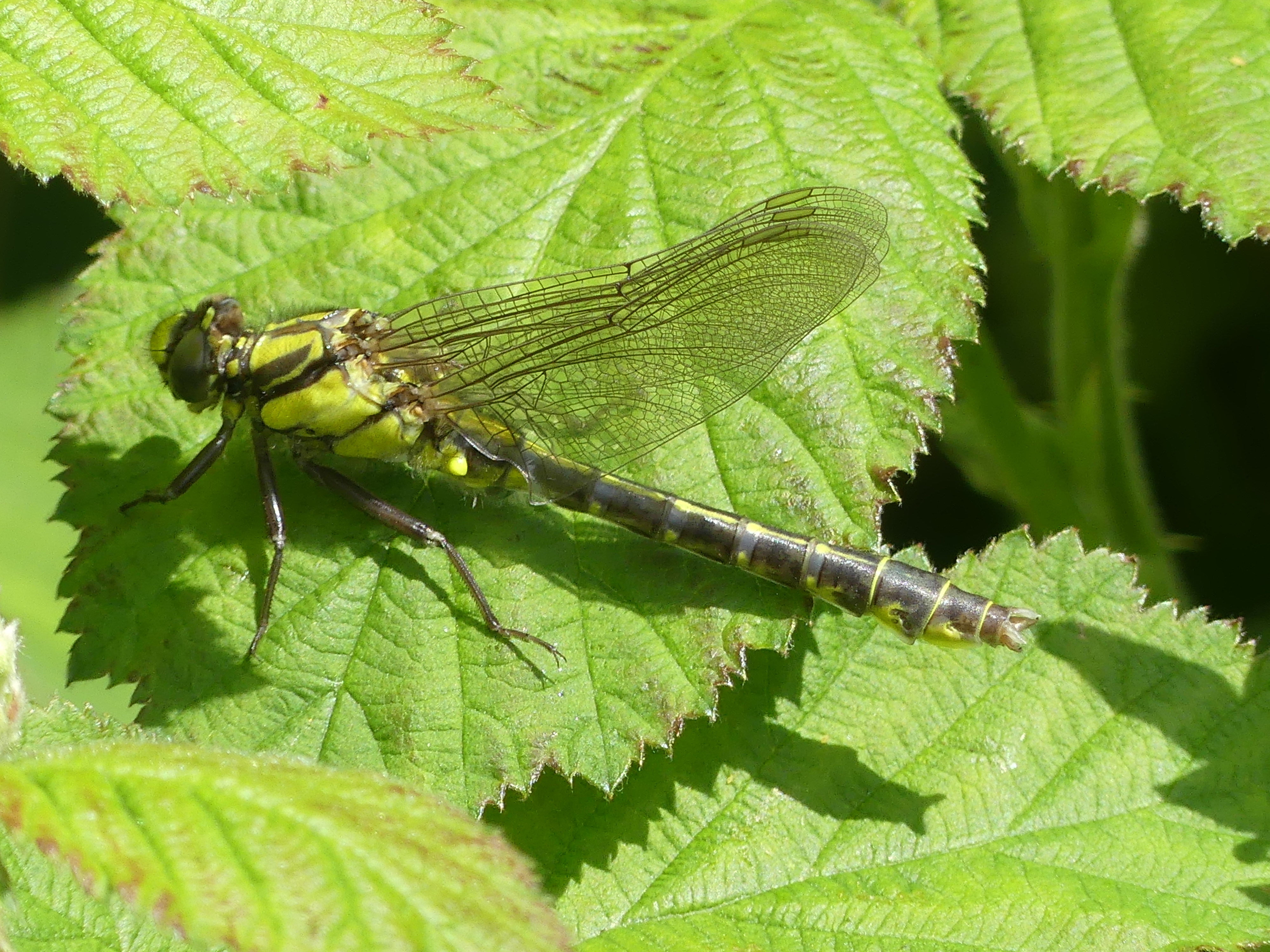
Our first find, an individual already moving away from the natal site.

Found about two metres from the river

Freshly emerged male, initially on a reed stem then moved three metres onto brambles.

Mayfly 

The riverside meadow had plenty of nettles and brambles that seem to be the favoured perch of the Clubtails. But there are some other wild flowers too.
  

Many of the Dandelions are almost ready for the seeds to be dispersed.

Ragged Robin

Oilseed Rape

    Purple flower Comfrey

Another location that can be reliable for them is Chosley Marsh a few miles up river form Goring. Another was fond on backside vegetation, making six for the day.

Common Clubtail